Pentacles are the suit of earth: the body, money, craft and the material world. They govern what can be counted, built, spent or inherited, along with health, home and the long, slow work of making things last. In the Ikonology deck they are the blue Diamonds, so if you play poker with this deck, every Pentacles card is also a diamond. This page covers all fourteen cards of the suit, from the Ace to the King, with a full upright meaning, a full reversed meaning and a note on the icon printed on each card.
If you own the deck, the short keyword versions of these meanings are on pages 27 to 30 of the booklet in the box. This is the longer version the booklet promised. If you don't own it yet, you can read this as a plain-spoken guide to the traditional meanings of the Pentacles cards, whatever deck you use. For the deck itself, see the Ikonology deck page.
Table of Contents
The Suit of Pentacles in Brief
The booklet sums up the suit this way: “Body, money, craft. What can be counted, built, spent or inherited. Health, home and the long slow work.” Before you read a single card, its suit has already told you what kind of matter you are looking at, and in a spread, a run of Pentacles cards suggests the question is mostly about the body, money and craft.
Each number carries its own weight whatever the suit. The Ace is the seed, the Two is duality, the Three is first growth, the Four is structure, the Five is disruption, the Six is recovery, the Seven is assessment, the Eight is movement, the Nine is near completion and the Ten is completion and excess. Read the number first, then the suit, and you have a working reading before you look anything up.
The court cards can be people, or they can be the manner in which you are acting. The Page is the student, the Jack is the Knight of tarot, the Queen is mastery held inwardly and the King is mastery expressed outwardly. In the Ikonology deck the Knight is called the Jack and is marked J, which is why a poker deck made from these cards has a full set of Jacks. Let the surrounding cards decide whether a court card is a person or an attitude.
Every Ikonology card reads one way up. The Roman numeral of a Major Arcana card sits at the top and its name at the bottom, and on the Minor Arcana the corner index sits at the top left. A card that lands the right way round is upright. A card that lands upside down is reversed, and reversed means the same energy in a different mood: blocked, delayed, turned inward or overdone. Reversals are optional, and you can turn every card upright if you prefer.
Ace of Pentacles (Ace of Diamonds)
A coin lands in your palm, and for once it's not counterfeit.
Ace of Pentacles Upright
The Ace of Pentacles is the seed of the earth suit: opportunity, prosperity and a seed planted. Traditionally a hand emerges from a cloud, offering a
large golden coin above a flourishing garden, with a path leading toward a gate in the hedge and distant mountains beyond. It's a gift of ground, the chance to build something real. The booklet calls the ace potential “offered but not yet taken up,” and here the potential is tangible: a job, a contract, a windfall, a home, a skill or a healthy new habit.
In a reading, the Ace of Pentacles says a solid opportunity is on the table, and it's worth taking seriously. Unlike the flashy sparks of the fire suit, this one grows slowly and pays off steadily. Plant it carefully, in good soil, with realistic expectations. Check the details, make a budget and take a first practical step. A seed is a promise, but only if you water it.
Ace of Pentacles Reversed
Reversed, the booklet reads lost chance, scarcity and poor planning. The coin has slipped through your fingers, or it was never as solid as it looked. It might be an opportunity missed because you hesitated, a financial plan with holes in it, or a feeling that there's never quite enough.
Look at what you can still do with what you have. A missed chance often leaves a smaller one behind it. Make a simple plan, tidy up the accounts and be realistic about timing. A reversed Ace isn't a verdict. It's a prompt to get practical.
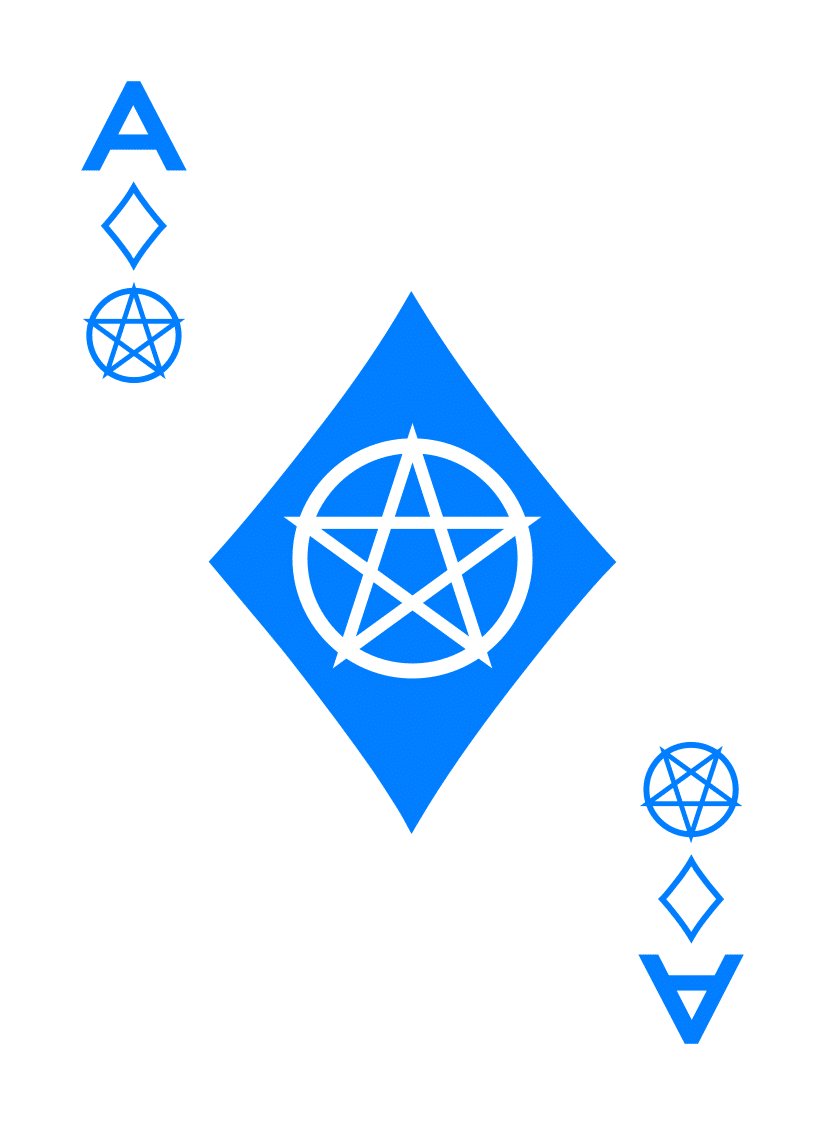
The Icon on the Ace of Pentacles
The Ikonology Ace of Pentacles is a large blue diamond with a five-pointed star in a ring set at its center. The diamond is the poker symbol and the pentacle is the tarot one, fused into a single image like every ace in the deck. It's compact, balanced and solid, which suits the suit: the symbol of something you can hold in your hand.
Two of Pentacles (Two of Diamonds)
Two coins, one very energetic juggle, and a ship sailing past while you keep up.
Two of Pentacles Upright
The Two of Pentacles is the card of balance, juggling and adaptability. The traditional picture shows a young person dancing and juggling two coins
connected by a looping ribbon in the shape of an infinity sign, while ships rise and fall on waves behind them. The booklet's number key calls two “duality,” choice, partnership and balance held between two things, and in the earth suit that means managing two practical demands at once: money and time, work and home, this bill and that deadline.
In a reading, the Two says you're handling several things at once, and doing it well enough, as long as you stay flexible. It's the card of the person with two jobs, a household budget and a lot of plates in the air. It advises a cheerful, nimble approach. Don't try to freeze the situation. Ride the waves, shift your weight and keep the coins moving. If there's trouble, it'll likely come from rigidity, not from the juggling itself.
Two of Pentacles Reversed
Reversed, the booklet gives overcommitment and disorganisation. A coin has dropped. The calendar's a mess, the bills are stacking up, and you said yes to one thing too many. It's the juggler who's gone from playful to frantic.
Triage. List everything, decide what truly matters, and put one or two items down. Delegation and saying no are skills, and so is asking for help. A reversed Two doesn't mean you're failing. It means your hands are full, and it's time to set something down.
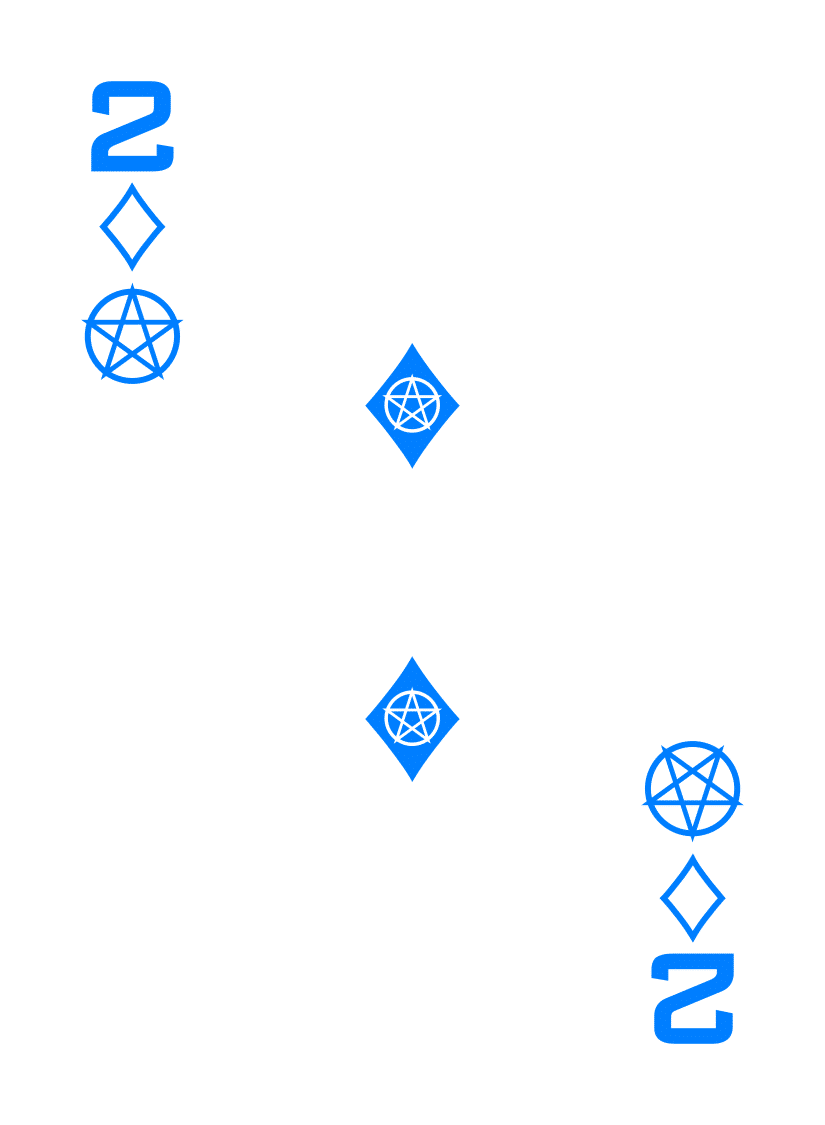
The Icon on the Two of Pentacles
Two blue diamonds with a tiny pentacle inside each, stacked in the center column. The two stacked pips look like a pair of coins in the air, one up and one down, in the middle of a juggle. The corner index shows the 2, an outlined diamond and a pentacle in a circle, with a second set upside down at the opposite corner.
Three of Pentacles (Three of Diamonds)
Three people, one blueprint, and an argument about the arch that turns out to be useful.
Three of Pentacles Upright
The Three of Pentacles is the card of teamwork, craft and skill recognized. The traditional picture shows a stonemason at work in a cathedral, with two others,
probably an architect and a patron, consulting plans beside him. Each brings something different, and the building rises because they talk. The booklet's number key calls three “first growth,” where the idea becomes real and others are involved, and in the earth suit that growth is built by collaboration.
In a reading, the Three says your work is being seen and valued, and the best results come from working with others. It's a card for projects, apprenticeships, group efforts and the satisfaction of a job well done. Listen to the plans as well as the tools. A good craftsman wants feedback, and a good team wants good craftsmanship. Show up, do your part properly and let your skill be known. Quality is the best advertisement you'll ever have.
Three of Pentacles Reversed
Reversed, the booklet gives poor collaboration and shoddy work. The architect and the mason aren't talking, or someone's cutting corners. It's the group project where no one agrees on the plan, the careless job that will need redoing, or the skill that nobody notices.
Ask where communication broke down. Often it's a simple lack of clarity about who's doing what. If the standard's slipping, say so, and say it early. A reversed Three asks you to work a bit more carefully and talk a bit more clearly, and the whole cathedral will stand a little straighter.
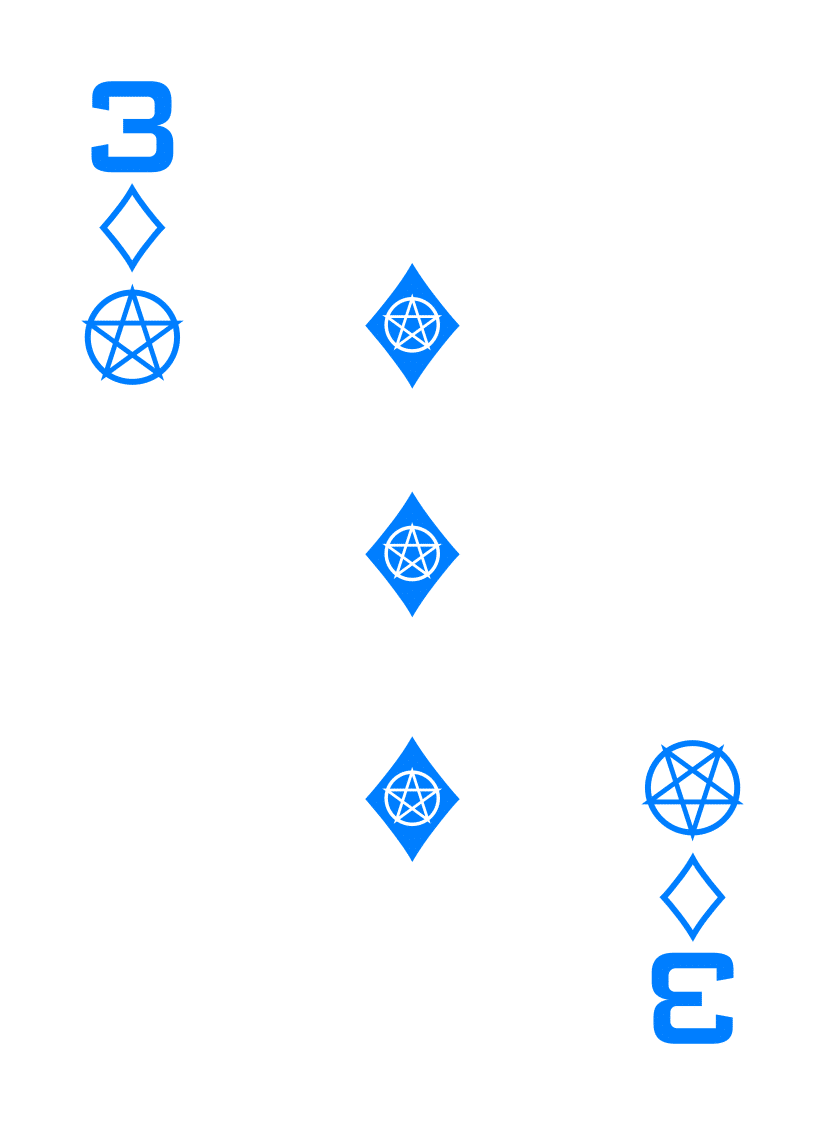
The Icon on the Three of Pentacles
Three blue diamonds, each holding a tiny pentacle, stacked in the center column. Three in a line looks like three stones stacked in a wall, or three tradespeople standing shoulder to shoulder at a drawing. It's a neat arrangement, with nothing wasted.
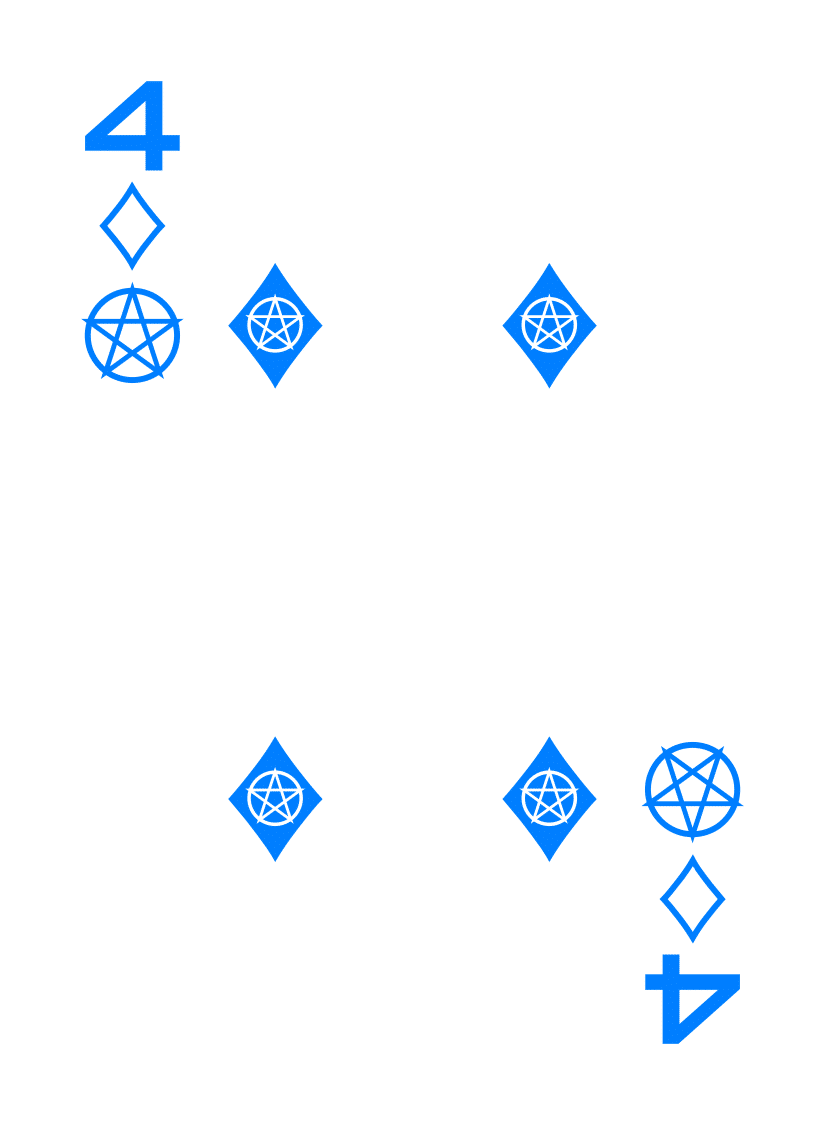
Four of Pentacles (Four of Diamonds)
One coin under each foot, one on the head, one in the arms. Nobody's getting that coin.
Four of Pentacles Upright
The Four of Pentacles is the card of security, saving and holding tight. The traditional picture shows a figure seated with a coin on their head, one clutched
to the chest and one under each foot, with a city behind them. They're not letting go of anything. The booklet's number key calls four “structure,” stability and the stagnation stability risks, and in the earth suit stability looks like a savings account.
In a reading, the Four can describe prudence: a sensible budget, a secure foundation, a determination to protect what you've earned. There's nothing wrong with wanting safety. The card also asks whether you're holding on too tightly. Security that costs you generosity, flexibility or peace of mind is expensive security. Keep what you need and ask whether the rest could be put to work. Money, like soil, does more good when it's spread around.
Four of Pentacles Reversed
Reversed, the booklet gives greed, hoarding and letting go. The grip has tightened into possessiveness, or it's finally loosening. The first version describes someone clinging to money, objects or control out of fear. The second is the relief of unclenching: spending on something meaningful, giving, trusting that there will be enough.
If you recognize the clutch, ask what you're afraid of. It's often something real, like a past shortage or a bad experience. A small, deliberate act of generosity can show you the world won't end. A reversed Four invites you to open one hand and see what happens.
The Icon on the Four of Pentacles
Four blue diamonds, each with a tiny pentacle, sitting at the four corners of an open rectangle. They look like coins held at the corners of a ledger, or the four spots on which the figure on the traditional card keeps his treasure. The wide gap in the middle is the card's quiet question: what's inside that you're holding so tight?
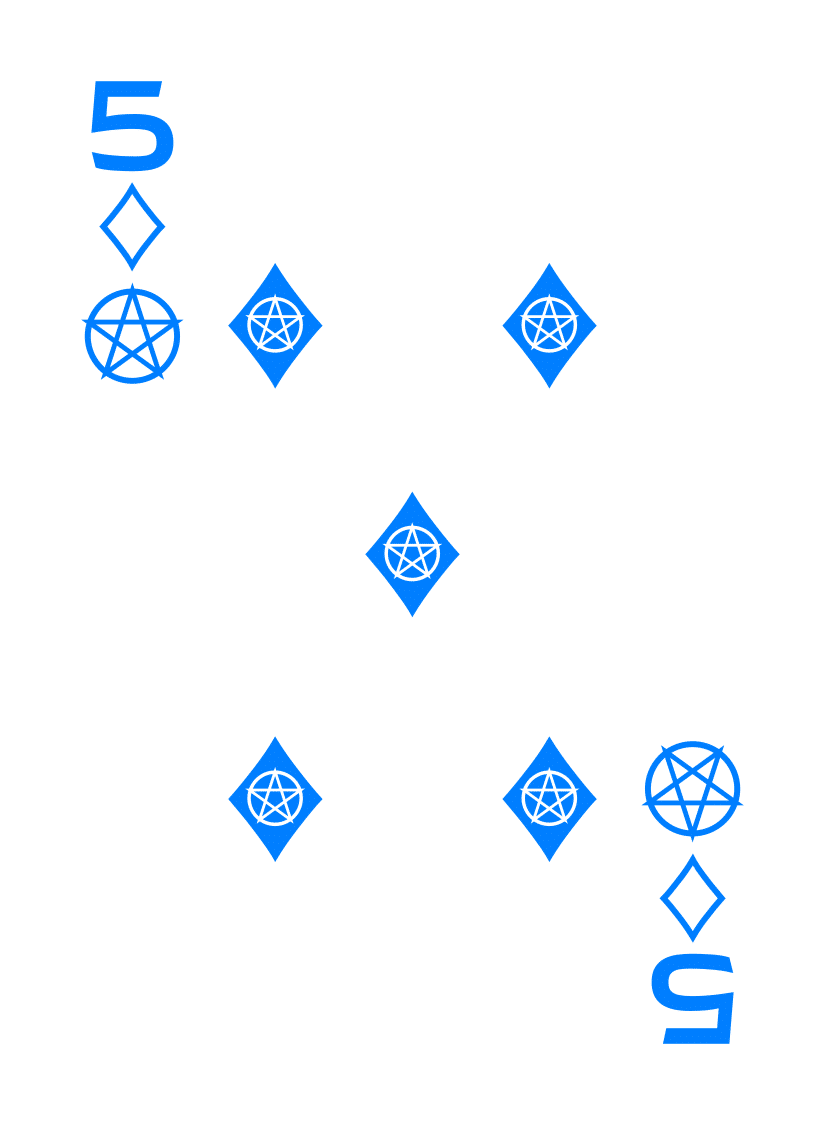
Five of Pentacles (Five of Diamonds)
Snow, a lit window and nobody opening the door. Knock. Please knock.
Five of Pentacles Upright
The Five of Pentacles is the card of hardship, insecurity and being left out in the cold. The traditional picture shows two ragged figures trudging
through snow past a glowing stained-glass window, one on crutches, neither looking up. Help is right there and they haven't seen it. The booklet's number key calls five “disruption,” loss, conflict and the necessary breaking of the four, and in the earth suit the break is financial or physical: a job lost, an illness, a bill too big.
In a reading, the Five acknowledges real difficulty. It might be money, health, housing or the lonely feeling of being outside the warmth. It isn't a punishment, and the card doesn't blame you. But it does point out the light in the window. There are people, services and sources of support nearby, and the hardest part is often asking. You don't have to do this alone. Let someone know, accept what's offered and take the first practical step toward getting warm.
Five of Pentacles Reversed
Reversed, the booklet gives recovery, help accepted and improvement. Somebody's opened the door. The winter's easing, a job has turned up, or you've finally asked for help and gotten it. It's one of the more heartening reversals in the deck.
Take care of the basics and don't rush the recovery. Pride, shame and fear are the usual obstacles, and they're worth setting down. When you're back on your feet, remember the cold and pass on the favor.
The Icon on the Five of Pentacles
Five blue diamonds with tiny pentacles, four at the corners and one in the middle, like the five on a die. The center pip is the one you can't reach, close to the rest and still out of the warmth. The card is spare and cool in color, a fair match for a bleak winter.
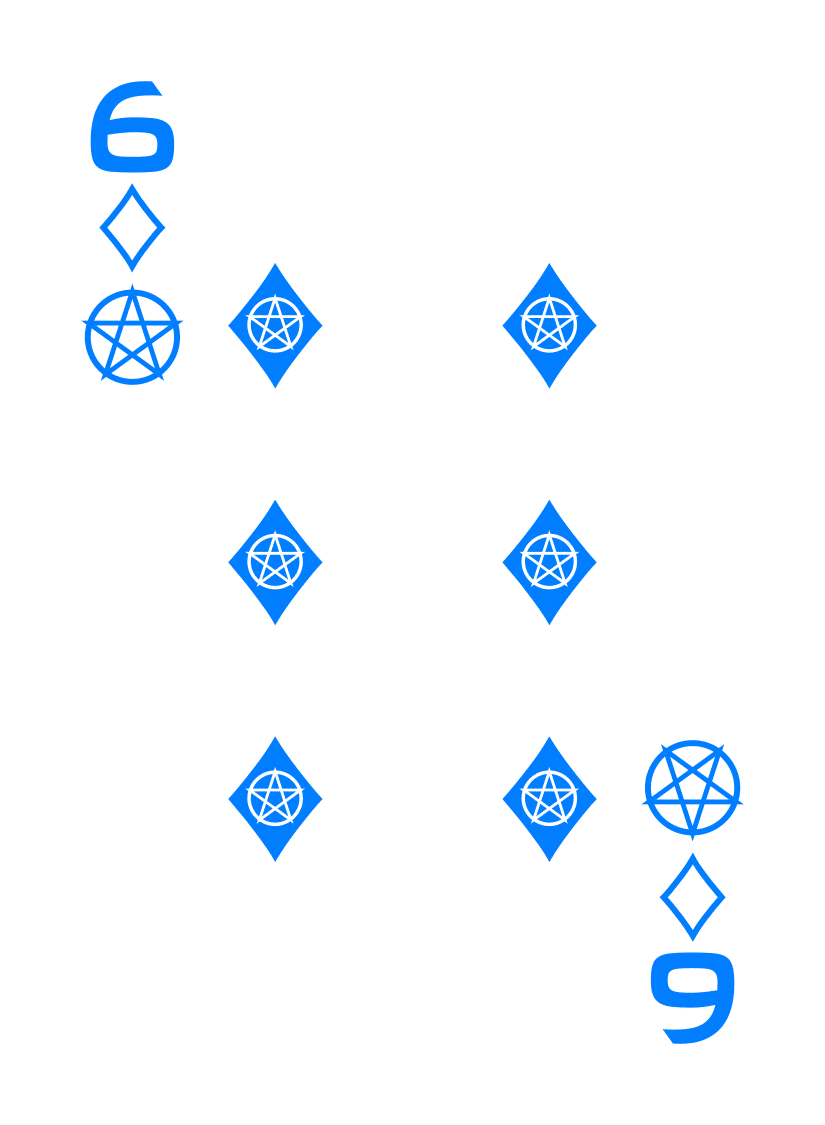
Six of Pentacles (Six of Diamonds)
Scales in one hand, coins in the other. Fairness is surprisingly satisfying.
Six of Pentacles Upright
The Six of Pentacles is the card of generosity, giving and receiving. The traditional picture shows a well-dressed merchant holding a set of scales, handing
coins to a pair of kneeling beggars. Giving and receiving are in balance, at least on the surface. The booklet's number key calls six “recovery,” harmony restored, generosity and movement onward, and in the earth suit the harmony is financial and fair.
In a reading, the Six says resources are moving. You might be giving, with a donation, a loan or a helping hand, or receiving: a bonus, a gift, a bit of support. Both are healthy, and both depend on honesty. The scales remind you to give what's fair and to accept what's offered without shame. This is also a card about sharing success. If you've done well, passing something on keeps the whole system flowing, and one day, you may be the one who needs it.
Six of Pentacles Reversed
Reversed, the booklet gives strings attached, debt and one-sided giving. The scales are tipped. A gift comes with conditions, a loan with unspoken expectations, or you're giving far more than you're getting. It can also describe debt that feels heavy, or a generosity that's really about control.
Check the terms. If help comes with strings, name them aloud. If you're giving too much, adjust. A reversed Six asks for clear agreements and fair exchanges. Generosity should leave both sides feeling better.
The Icon on the Six of Pentacles
Six blue diamonds with tiny pentacles in two even columns of three. The matching columns look like the pans of a scale, perfectly level, with a central channel between them where goods pass. It's the most even-handed Pentacles layout, appropriately.
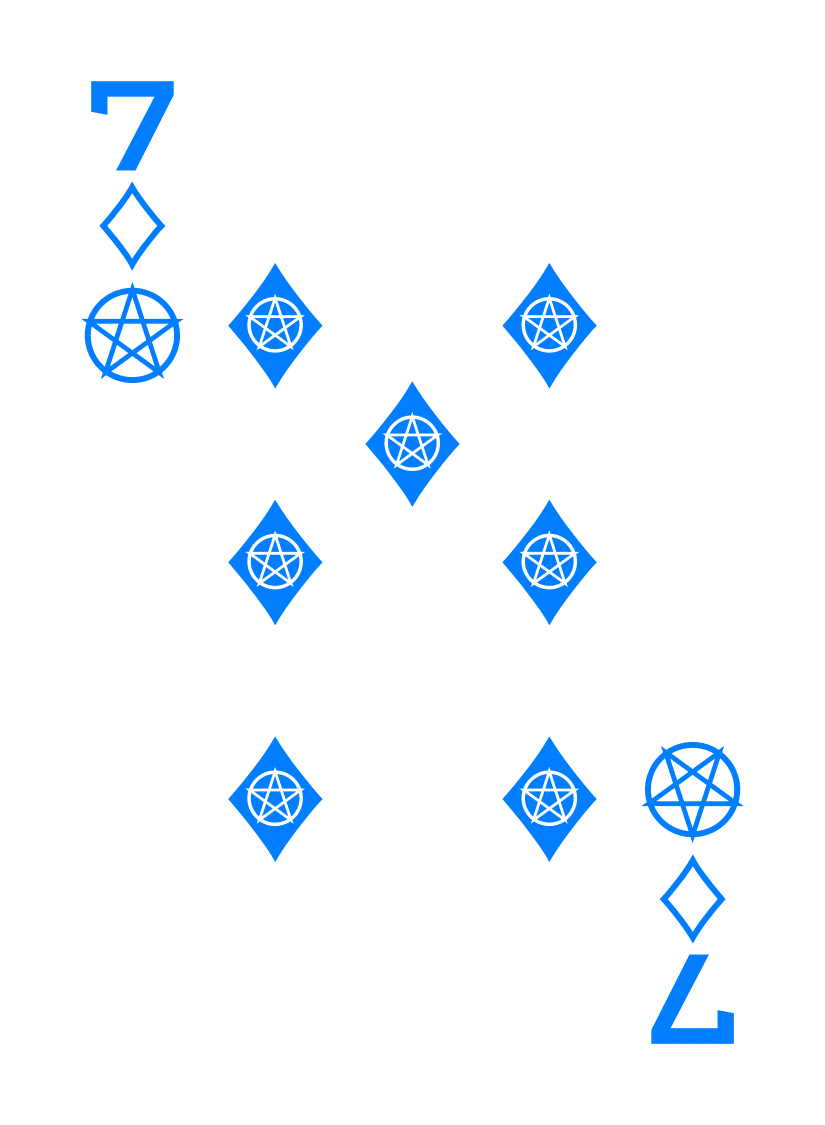
Seven of Pentacles (Seven of Diamonds)
The garden is growing. It isn't growing faster because you stared at it.
Seven of Pentacles Upright
The Seven of Pentacles is the card of patience, the long view and investment. The traditional picture shows a gardener leaning on a hoe, looking at a vine
heavy with seven coins. The work's been done, and the crop is not yet ready. The booklet's number key calls seven “assessment,” reflection, challenge and the value of what you hold, and in the earth suit that means stepping back, looking at what you've planted and judging what's next.
In a reading, the Seven asks you to be patient. You've put in the effort, and results take time. It's a card for savings, long projects, slow-growing relationships and any endeavor where the harvest lags behind the work. It also invites an honest review. Is the vine healthy? Is this still the right crop? Pull the weeds, water what's worth watering and trust the process. Stay steady, and let the season do its part.
Seven of Pentacles Reversed
Reversed, the booklet gives impatience, poor return and wasted effort. You're digging up the seeds to check on them, or you've put hard work into something that isn't paying off. It can describe an investment that's underperforming, or frustration that things aren't moving as quickly as you'd hoped.
Ask whether the problem is timing or direction. If it's timing, wait. If it's direction, change the crop. Either way, don't take it personally. A reversed Seven is a prompt to inspect your garden and decide where your next hour of work will do the most good.
The Icon on the Seven of Pentacles
Seven blue diamonds with tiny pentacles: two columns of three with one extra between the first and second rows. The extra pip hangs among the rest like a coin on the vine, a little apart, ripening. Seven pips in a loose arrangement gives the card a feeling of patient waiting.
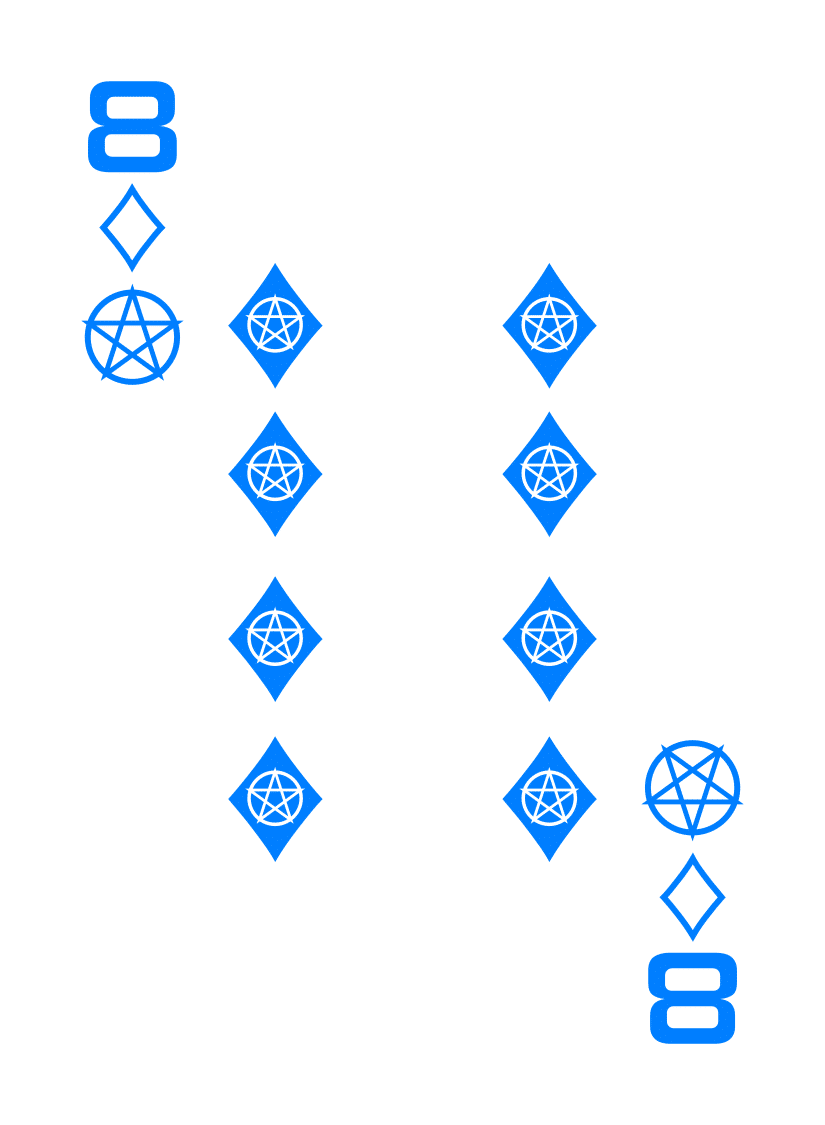
Eight of Pentacles (Eight of Diamonds)
Tap, tap, tap. Another one. Slightly better than the last. This is how it's done.
Eight of Pentacles Upright
The Eight of Pentacles is the card of apprenticeship, diligence and mastery. The traditional picture shows a craftsman at a bench, carving pentacles one after
another, with finished ones displayed in front of him. There's nothing glamorous about it, and nothing wasted either. The booklet's number key calls eight “movement,” mastery through repetition or swift change forced on you, and in the earth suit it's mastery by practice.
In a reading, the Eight celebrates steady, focused work. It's the card of learning a trade, practicing an instrument, perfecting a method or putting in the hours on a project that matters. It says that skill is built, not born, and that the repetition you find tedious is what makes you good. Settle in, pay attention to the details, and take quiet pride in your craft. Excellence is the result of showing up again and again.
Eight of Pentacles Reversed
Reversed, the booklet gives perfectionism and misdirected effort. The craftsman is polishing the same coin for the fortieth time, or he's making the wrong thing altogether. It describes hard work that's not going anywhere: over-engineering, endless tweaking, or effort spent on the wrong goal.
Ask what “good enough” looks like, and whether this is still the right project. Finishing something imperfectly is better than perfecting something you never finish. Ship it, learn from it and make the next one better.
The Icon on the Eight of Pentacles
Eight blue diamonds with tiny pentacles, in two columns of four, lined up like a row of finished coins on a bench. The tidy rows reflect the careful repetition of the craft. Every pip is the same size and the same distance from the next, a quiet picture of consistency.
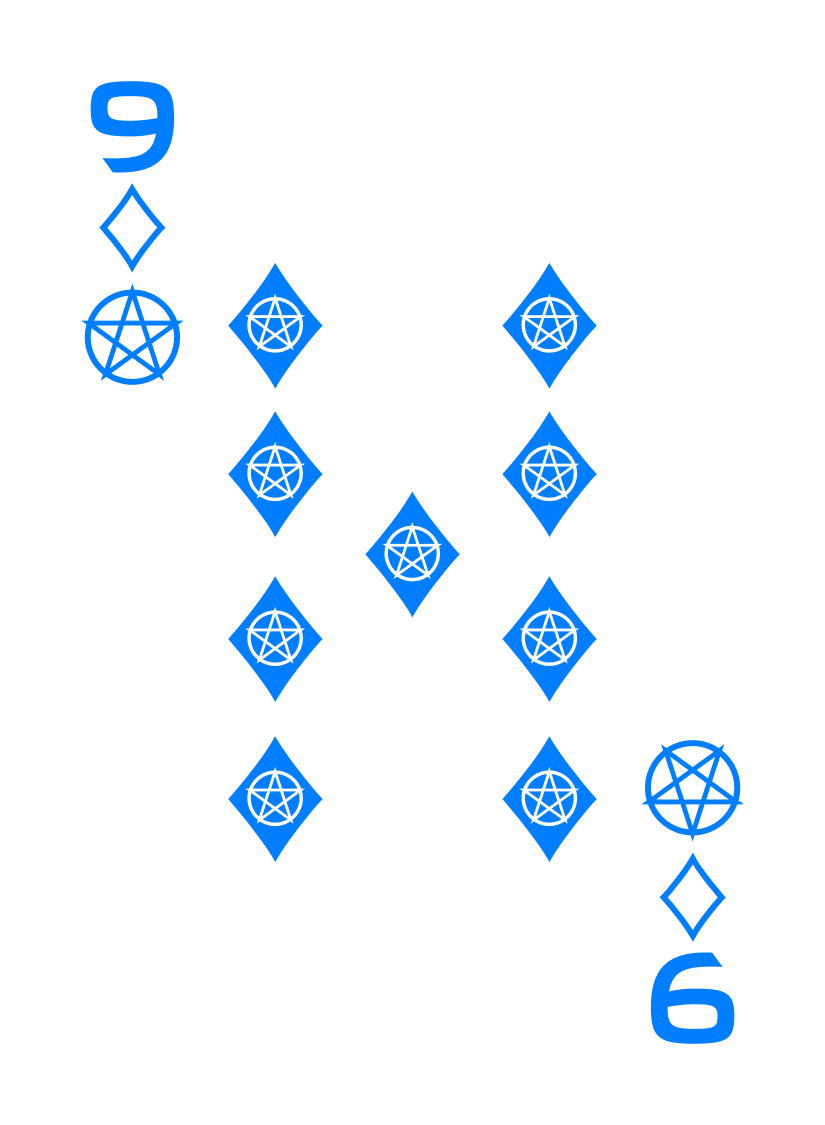
Nine of Pentacles (Nine of Diamonds)
A garden, a bird, a good book and no one's asked her for anything. Heaven.
Nine of Pentacles Upright
The Nine of Pentacles is the card of self-sufficiency and earned comfort. The traditional picture shows a well-dressed woman in a vineyard with a falcon on her
glove, surrounded by ripe grapes and golden coins. She's built this life, and it's hers. The booklet's number key calls nine “near completion,” the fruit of the suit felt alone, and in the earth suit the fruit is financial and personal independence.
In a reading, the Nine celebrates what you've created. You've worked, saved and built something that gives you freedom, and you're allowed to enjoy it. It's a card of refined taste, quiet confidence and the pleasure of your own company. Take time in your garden. At the same time, it suggests that self-sufficiency is a strength, not a barrier. You can be independent and still welcome good company.
Nine of Pentacles Reversed
Reversed, the booklet gives overwork and hustle without rest. The vineyard's a bit bare. You're building the comfortable life and never getting to use it, grinding through the days with no breaks, or confusing busyness with security.
Ask what the work is for. If comfort is the goal, schedule some. Take the holiday, buy the nice thing, spend an afternoon doing nothing. A reversed Nine invites you to stop earning your life long enough to live it.
The Icon on the Nine of Pentacles
Nine blue diamonds with tiny pentacles: two columns of four, with one in the center like a figure standing alone in a garden. The ring of pips around it gives a sense of enclosure and ownership. The corner index repeats at the opposite corner, upside down.
In a reading, the Nine says you've got something to be happy about. You've worked for it, or hoped for it, and it has arrived. The card also encourages you to take pleasure in what you have: a good meal, a cozy home, a hard-earned success. Enjoy it without apology. There's a gentle caution, too. Satisfaction can be a solo sport, and the sweetest wishes are better when you share them. Invite someone to the table.
Nine of Cups Reversed
Reversed, the booklet gives smugness, materialism and hollow pleasure. The wish came true, and it doesn't feel as good as you expected. You've piled up the comforts and the satisfaction slipped away, or you're so pleased with yourself that you've stopped noticing everyone else.
If the pleasures feel hollow, ask what you actually wanted underneath the wish. A bigger house won't fix loneliness, and a pay rise won't cure a bad fit. If it's smugness, a little humility goes a long way. Either way, the reversed Nine invites you to chase something that satisfies rather than something that merely impresses.
The Icon on the Nine of Cups
Nine red cups with hearts: two columns of four, with one in the center, like a cup placed in the middle of the table. The center cup is the one the figure has their eye on. The corner index repeats at the lower right, upside down, so that the card reads from either side.
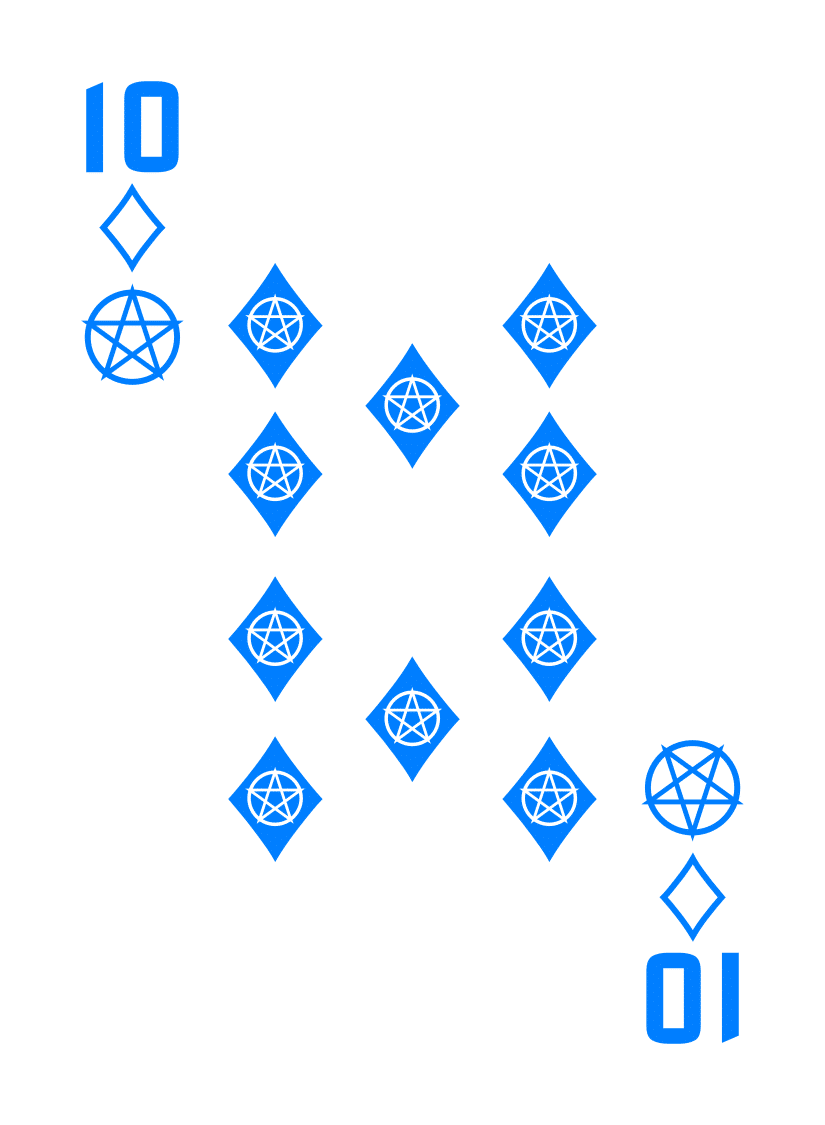
Ten of Pentacles (Ten of Diamonds)
Three generations, two dogs, a good arch and an inheritance that includes the dishes.
Ten of Pentacles Upright
The Ten of Pentacles is the card of legacy, inheritance and lasting wealth. The traditional picture shows an elderly man seated beneath an archway, with a couple
and a child beside him, dogs at his feet and a grand estate behind. It's wealth that's grown across generations: money, property, tradition and family. The booklet's number key calls ten “completion and excess,” the suit at its fullest and the end of the cycle.
In a reading, the Ten points to long-term security. It can mean financial stability, an inheritance, a family business, a well-established home or a legacy you're building. It's about what lasts: relationships, values and assets that outlive a single season. Think about the long view. What do you want to pass on? Make decisions that your future self and your family will be glad of. And enjoy the sense of belonging to something larger than your own days.
Ten of Pentacles Reversed
Reversed, the booklet gives fleeting success and financial failure. The estate's less secure than it looks. A windfall evaporates, a family business falters, or the wealth was never as solid as it seemed. It can also describe family conflict over money, or a legacy that's more burden than gift.
Review the foundations. Are the finances sound? Are the family agreements clear? Hard conversations about money and inheritance are easier now than later. A reversed Ten asks you to build something that can survive you, and to start with honest books.
The Icon on the Ten of Pentacles
Ten blue diamonds, each with a tiny pentacle, in two columns of four plus two in the middle column. It's the fullest Pentacles card, with a coin for every square inch, and it looks like a ledger page that has finally balanced. The crowded face matches the number key: the suit at its fullest.
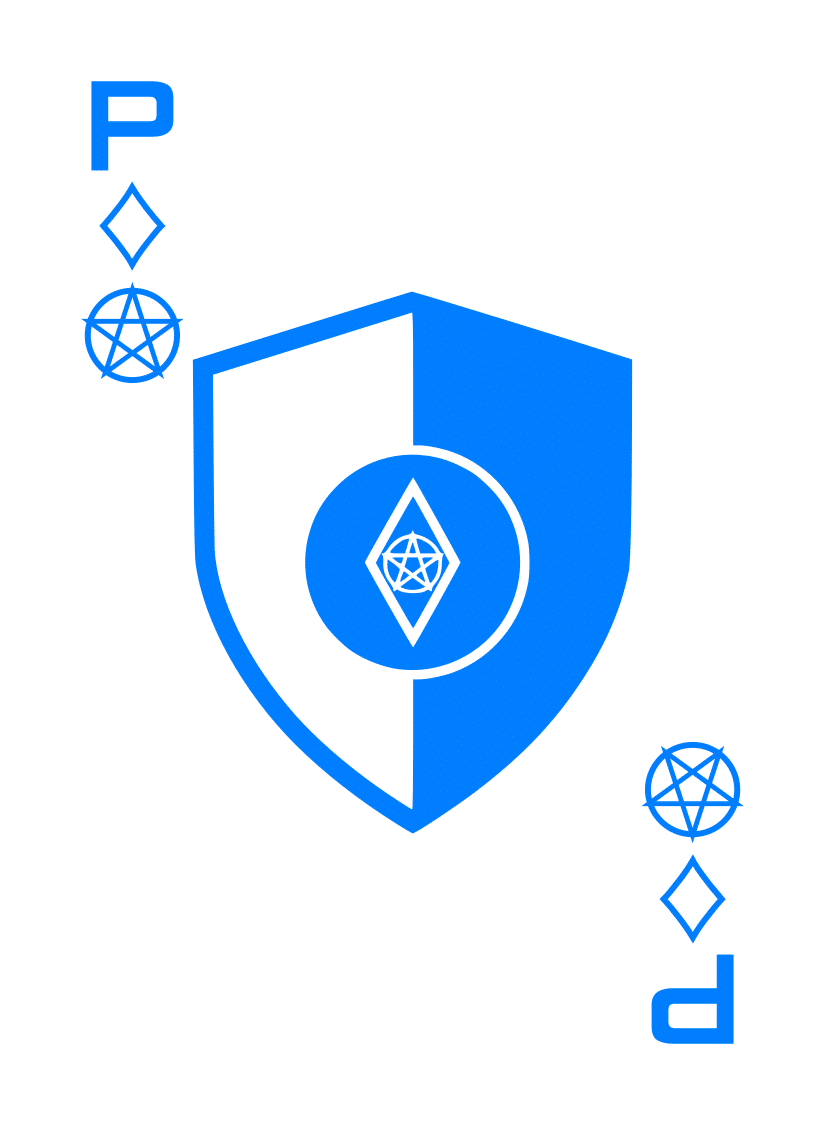
Page of Pentacles
Holding a coin and staring at it like it might say something. It might.
Page of Pentacles Upright
The Page of Pentacles is the student of the earth suit: study, a new venture and manifestation. The booklet describes Pages as “the student,” curiosity, a message arriving and a beginning taken seriously. In the
traditional picture, a young person stands in a field, gazing at a coin held in both hands, as if working out what it could become. They're not rushing. They want to understand it first.
In a reading, the Page of Pentacles can be a studious, careful person or the start of a practical project: a course, an apprenticeship, a business plan, a savings goal. It's an invitation to learn something useful and to take your time doing it. Begin with a small, realistic first step. The results come slowly, and that's fine. A good foundation is worth more than a fast start. Study the coin.
Page of Pentacles Reversed
Reversed, the booklet gives procrastination and no progress. The coin's still in your hands, and nothing's happened to it. The plans are made and the books are bought, and you haven't opened them. Or the effort is there, but it isn't leading anywhere.
Make the first step smaller. Fifteen minutes today beats a perfect plan next month. If you're stuck because it feels too big, break it into parts and do one. The reversed Page asks you to turn thought into action, a little at a time.
The Icon on the Page of Pentacles
The Page is a blue shield split into a solid half and an outlined half, with a circular emblem at the center holding the diamond-and-pentacle symbol. The half-and-half look suits a student whose work is half done. The emblem's a small, neat coin, which is all the Page of Pentacles has to start with, and exactly what they need.
Jack of Pentacles (Knight of Pentacles)
Not fast. Not flashy. But he will absolutely finish the job.
Jack of Pentacles Upright
The Jack of Pentacles is the Knight of the earth suit: routine, reliability and steady method. The booklet describes the Jack as “the Knight of tarot,” motion, commitment, the suit pursued at speed, though in this
suit “speed” is a relative term. The traditional picture shows a knight on a heavy horse, standing still in a plowed field, holding up a coin and thinking about it carefully. He's the one who's never late and never loses the paperwork.
In a reading, the Jack of Pentacles values dependability. He represents a practical approach: a plan, a schedule, a steady pace and a commitment to see it through. Whatever you're working on, this card suggests patient, methodical progress, one furrow at a time. It's not exciting, and it's what gets harvests in. Be consistent, do the job right and trust that steady effort will build more than a burst of inspiration.
Jack of Pentacles Reversed
Reversed, the booklet gives boredom, stagnation and obsessive detail. The routine has hardened into a rut. The plowing never ends, the checking never stops, and nothing new gets tried. It can describe a stubborn refusal to change method, or over-attention to small things at the expense of the big one.
Ask whether the system still serves you. A little variety can be healthy, and so can a little trust. The reversed Jack asks you to look up from the furrow and check that you're still plowing the right field.
The Icon on the Jack of Pentacles
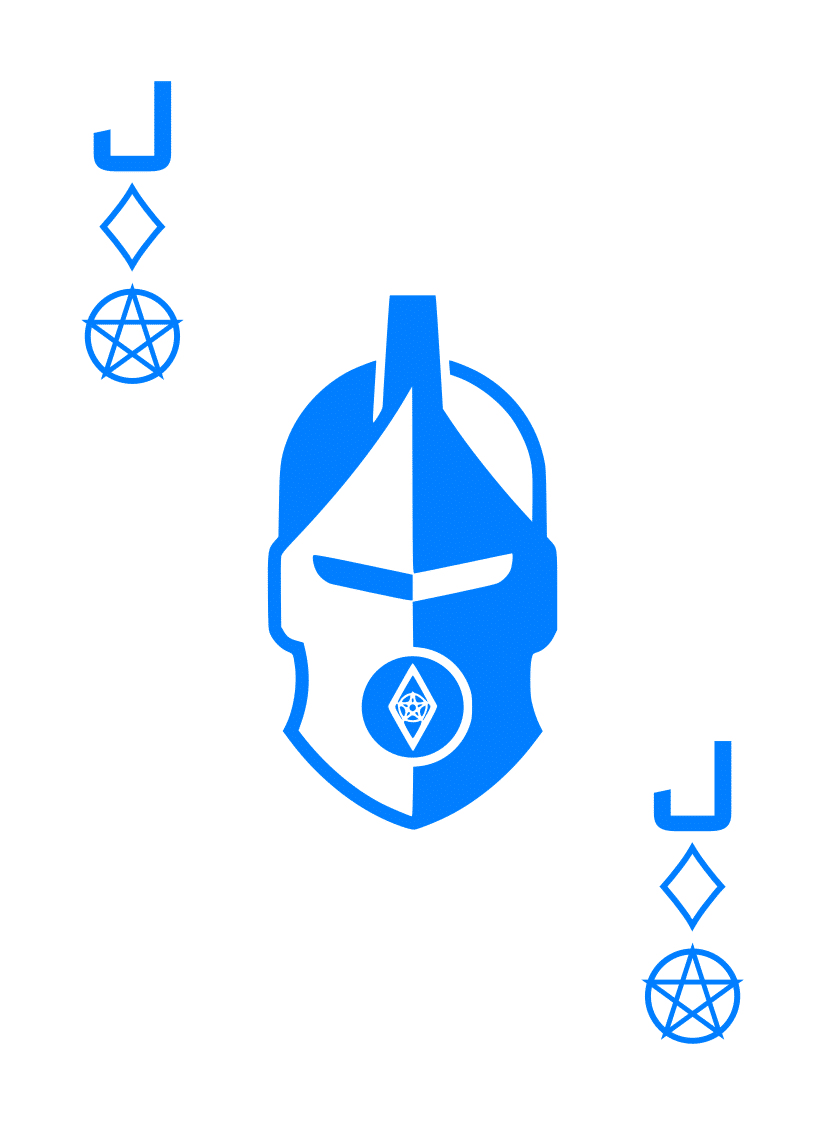
The Jack is a blue knight's helmet with a visor slit and a crest, split half solid and half outlined, with the diamond-and-pentacle emblem at the cheek. It's the same helmet as every other Jack, which is the point: a uniform. In blue, it looks suitably steady, a helmet built to last.
Queen of Pentacles (Queen of Diamonds)
She's got the budget, the casserole and the contact for a good plumber. Do not underestimate her.
Queen of Pentacles Upright
The Queen of Pentacles is practicality, nurture and resourcefulness. The booklet describes the Queens as mastery “held inwardly,” the suit understood,
embodied and used with judgement rather than force. In the earth suit, that means someone who has made a comfortable, productive home of her corner of the world. Traditionally she sits in a lush garden, a coin cradled in her lap, a small animal at her feet.
In a reading, the Queen of Pentacles can describe a generous, capable person who creates security for everyone around her, or invites you to be that person. She advises you to take care of the practical side of life: the money, the home, the body, the people who rely on you. She shows how to be warm and sensible at the same time. Make things comfortable. Make things last. Do it with a bit of style.
Queen of Pentacles Reversed
Reversed, the booklet gives neglected self-care and imbalance. The one who cares for everyone has forgotten about herself. The garden's overgrown, the accounts are neglected, and she's running on empty. It can also mean that work and home have gotten out of proportion, with one swallowing the other.
Look at what's been left out. A decent meal, a night's sleep, a quiet hour of your own. The reversed Queen asks you to put yourself on the list. A good provider who's exhausted can't provide for long.
The Icon on the Queen of Pentacles
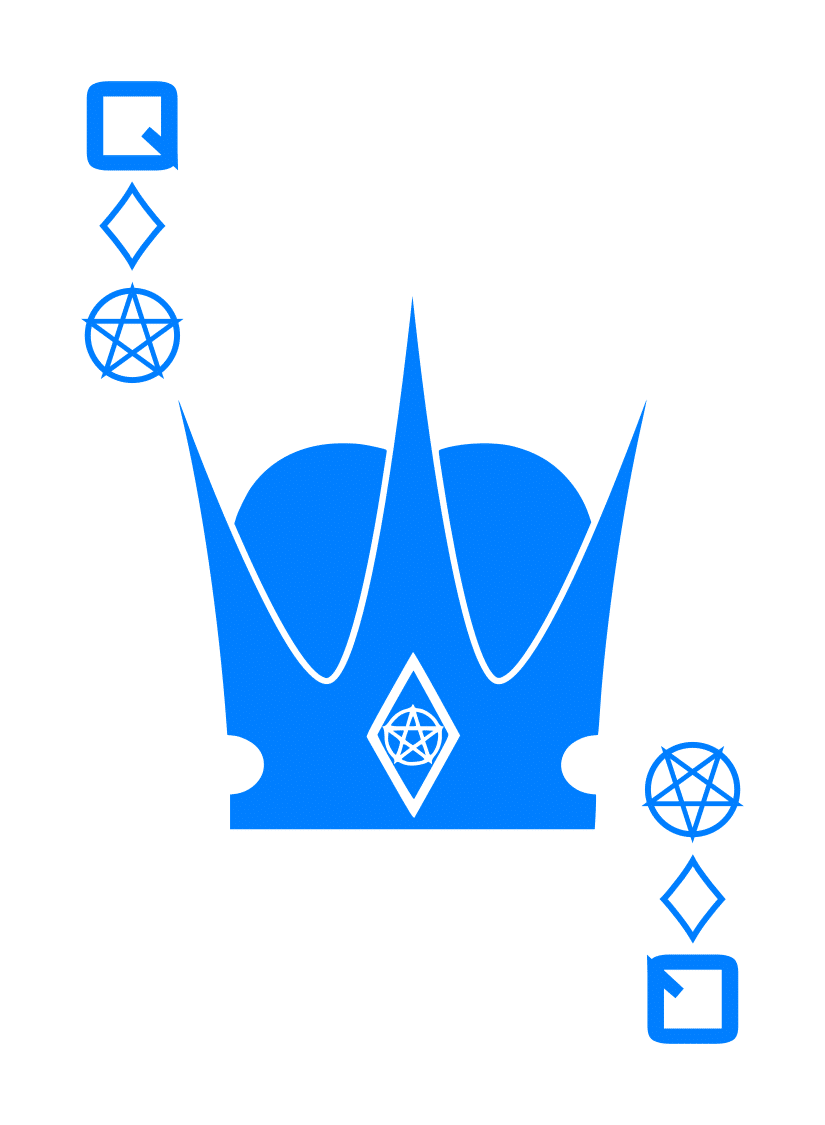
The Queen is a blue crown with a rounded, domed center between two tall points, small notches at the base and the diamond-and-pentacle emblem set into the band. The dome has the look of a hill or a loaf: solid, generous and comfortable. It's a crown for someone who prefers a kitchen to a throne room.
King of Pentacles (King of Diamonds)
His empire has a spreadsheet, and the spreadsheet balances. Yes, really.
King of Pentacles Upright
The King of Pentacles is wealth, enterprise and secure leadership. The booklet describes the Kings as mastery “expressed outwardly,” authority in the suit's
territory and responsibility for it. In the earth suit, that means a builder: someone who has turned effort into lasting prosperity and uses it to support others. Traditionally he sits among vines and bulls and castles, a picture of earned abundance.
In a reading, the King of Pentacles describes a stable, generous and shrewd person: a successful businessperson, a patient mentor, a solid provider. Or he invites you to take a similar approach: plan well, build slowly, protect what you've made and share it. He's the card of practical leadership and long-term thinking, and of a sense that wealth is a means to take care of people and places. Think of what you could build that would still be standing in twenty years.
King of Pentacles Reversed
Reversed, the booklet gives greed, stubbornness and materialism. The abundance has become a possession. Wealth is measured against other people's, decisions are driven by fear of loss, and the mind is closed to anything that might cost something. It describes the boss who values assets over people, or your own habit of counting before you feel.
Ask what the money is meant to do. Wealth that's used for security and generosity is a good thing. Wealth that's used for status or control is a trap. The reversed King asks you to loosen your hold, let a little in and out, and remember what the treasure's for.
The Icon on the King of Pentacles
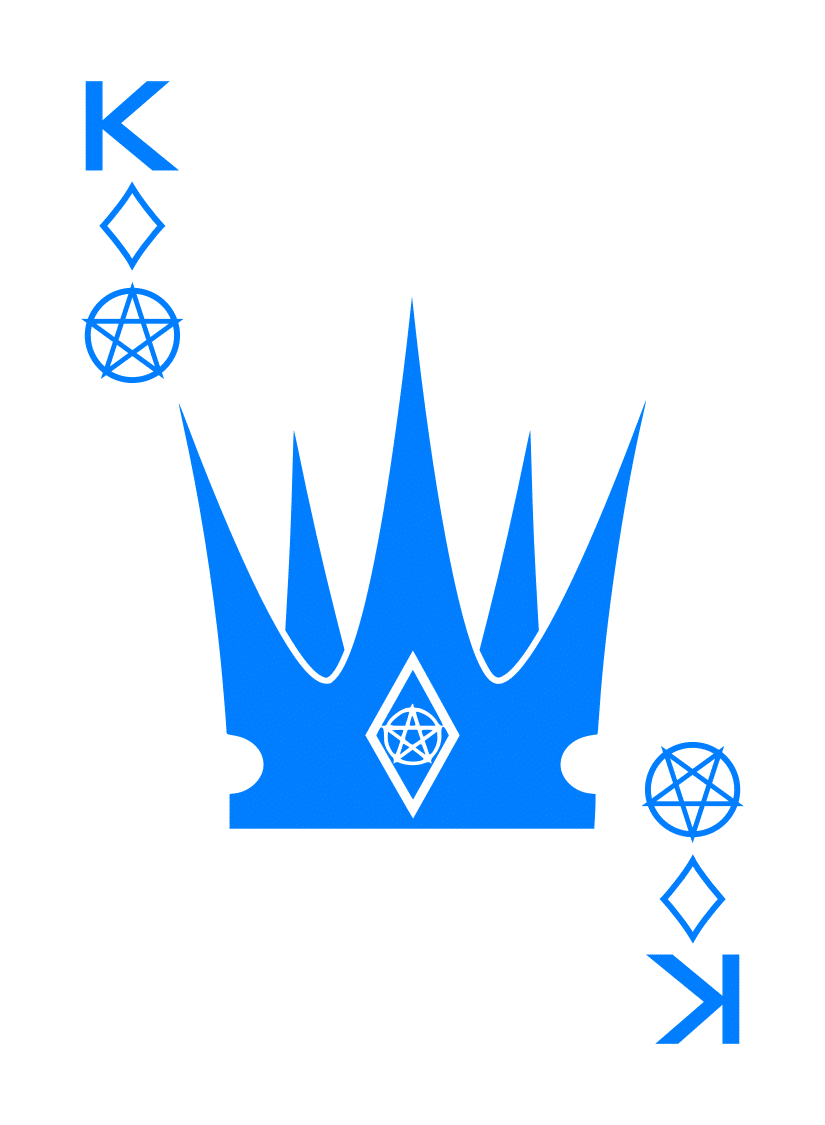
The King is the tallest crown in the blue suit: a central spire with shorter spikes on each side, notches at the base and the diamond-and-pentacle emblem at the center. It's built from the same shapes as the other three Kings, and in blue it looks both regal and sensible. The pentacle at its center is a reminder of what the crown is built on.
Where to Go From Here
The Pentacles are one of four suits in the Minor Arcana. For the rest of the deck, start with the twenty-two big cards of the Major Arcana, then move on to the other three suits:
- Ikonology Major Arcana meanings
- Ikonology Wands (Clubs) meanings
- Ikonology Cups (Hearts) meanings
- Ikonology Swords (Spades) meanings
Frequently Asked Questions
What does the suit of Pentacles mean in tarot?
Pentacles represent earth: the body, money, craft and the material world. They cover health, home and the long slow work of building something that lasts. In the Ikonology deck they're the blue Diamonds.
Are Pentacles the same as Diamonds in a regular deck?
Yes. In the Ikonology deck every Pentacles card doubles as a diamond when you play poker, so the same card has a tarot meaning and a poker rank. The Page has no poker equivalent and sits out of the poker deck, along with the Major Arcana.
What is the Jack of Pentacles?
It's the Knight of Pentacles. The Ikonology deck calls the Knight a Jack and marks it J, so that the deck works as a standard fifty-two-card poker deck once the Majors and Pages are removed.
Do I have to use reversed meanings?
No. Many readers never use them. Each Ikonology card reads one way up, so you can read reversals when you want them and turn every card upright when you don't.
Where can I buy the deck?
Ikonology is available from The Game Crafter. Get Ikonology here.
Check Out FatMunkey's Books
FatMunkey has a huge selection of sudoku and other puzzle books you are sure to enjoy.
Have look at this post to see all of the books and read about what FatMunkey has published so far.