The Major Arcana are the twenty-two big cards of a tarot deck, the ones with names and numbers instead of suits: from The Fool at zero to The World at twenty-one. They tell a story, and in the Ikonology deck each chapter of that story is told with a single bold icon inside a black circle. This page walks through all twenty-two, with a full upright meaning, a full reversed meaning and a short note on why each icon looks the way it does.
If you own the deck, you'll find the short keyword versions of these meanings on pages 4 to 11 of the booklet in the box. This page is the longer version, the one the booklet promised. If you don't own it yet, you can read the whole thing as a plain-spoken guide to the traditional meanings of the Major Arcana, whatever deck you use. For the deck itself, see the Ikonology deck page.
Table of Contents
How to Read Upright and Reversed Cards
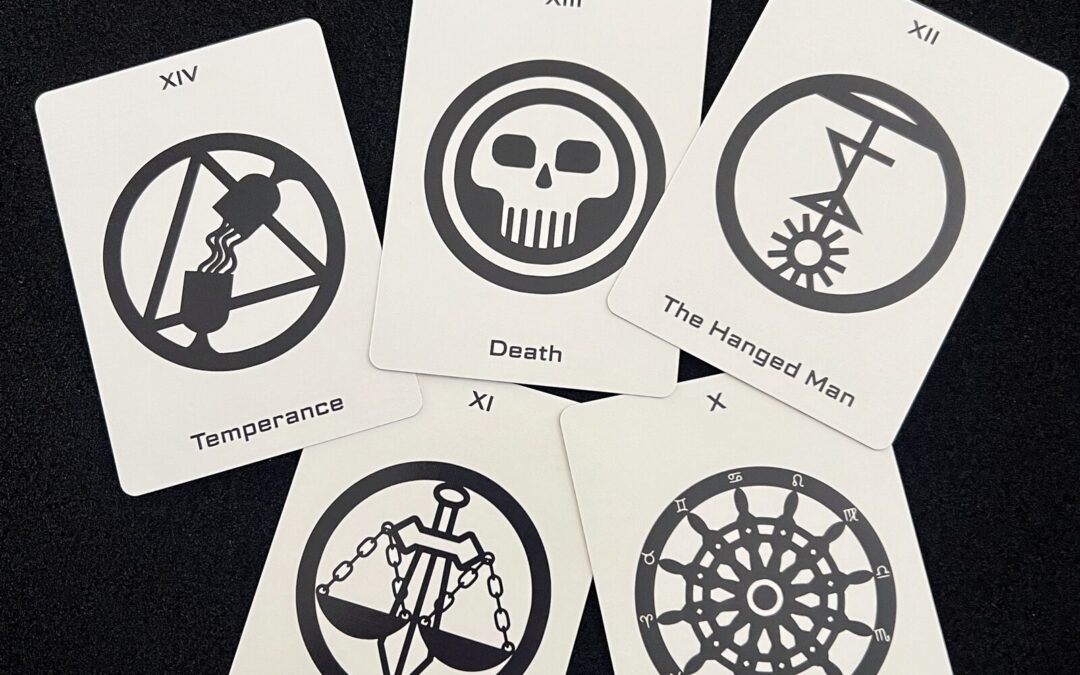
Every Major Arcana card in the Ikonology deck has its Roman numeral at the top and its name at the bottom, so you can always tell which way is up. Draw a card that reads the right way round and you read the upright meaning. Draw it upside down, with the name above the icon and the numeral below it, and you read the reversed one. Reversed doesn't mean “bad” and it rarely means the opposite. Think of it as the same energy in a different mood: blocked, turned inward, delayed, or heading toward the exit. Some cards get more interesting upside down, and some are simply the same card having a bad day.
Reversals are entirely optional. If you'd rather keep things simple, shuffle the cards so they all face the same way and read everything upright. The upright sections below stand on their own. And if you're using the Ikonology deck as a poker deck or for solitaire, the Majors are simply set aside, so none of this affects play.
The Fool
Step one is always the scary one, and the Fool just took it in mismatched socks.
The Fool Upright
The Fool is the first card in the deck, numbered zero, which is a polite way of saying it doesn't count against anything yet. It stands for new beginnings, innocence, spontaneity and the leap of faith: the moment you commit to something before you have every answer. Picture someone at the edge of a cliff with a small bag over one shoulder, whistling, not looking down. That's the card's whole attitude. It isn't stupidity, exactly. It's the willingness to start before you're fully ready, which, if we're being fair, is the only way anything ever gets started.
In a reading, the Fool says the road is open and the first step is yours. A new job, a move, a creative project, a relationship, a late-in-life hobby with expensive equipment: the Fool wants you to begin and to trust that you'll work out the rest on the way. When it lands on a question you've been chewing on for weeks, it often means you already know the answer and are waiting for permission. Consider it granted. Pack light, stay curious, bring a snack.
The Fool Reversed
Turn the Fool upside down and it keeps its charm but loses its eyesight. Reversed, this card points to recklessness, naivety and ignoring the risk: the leap taken with no glance at what's below. It can describe a plan with no plan in it, a big promise made on a whim, or advice ignored because it came from the one person who keeps asking annoying questions.
Sometimes the reversal runs the other way and you're the one frozen at the edge, so busy rehearsing the fall that the opportunity wanders off. Ask yourself which one it is. Are you charging ahead blind, or standing still with a perfectly good map? Either way, the reversed Fool asks for one honest look at the ground before the next step. Then, if you still want to, jump.
The Icon on The Fool
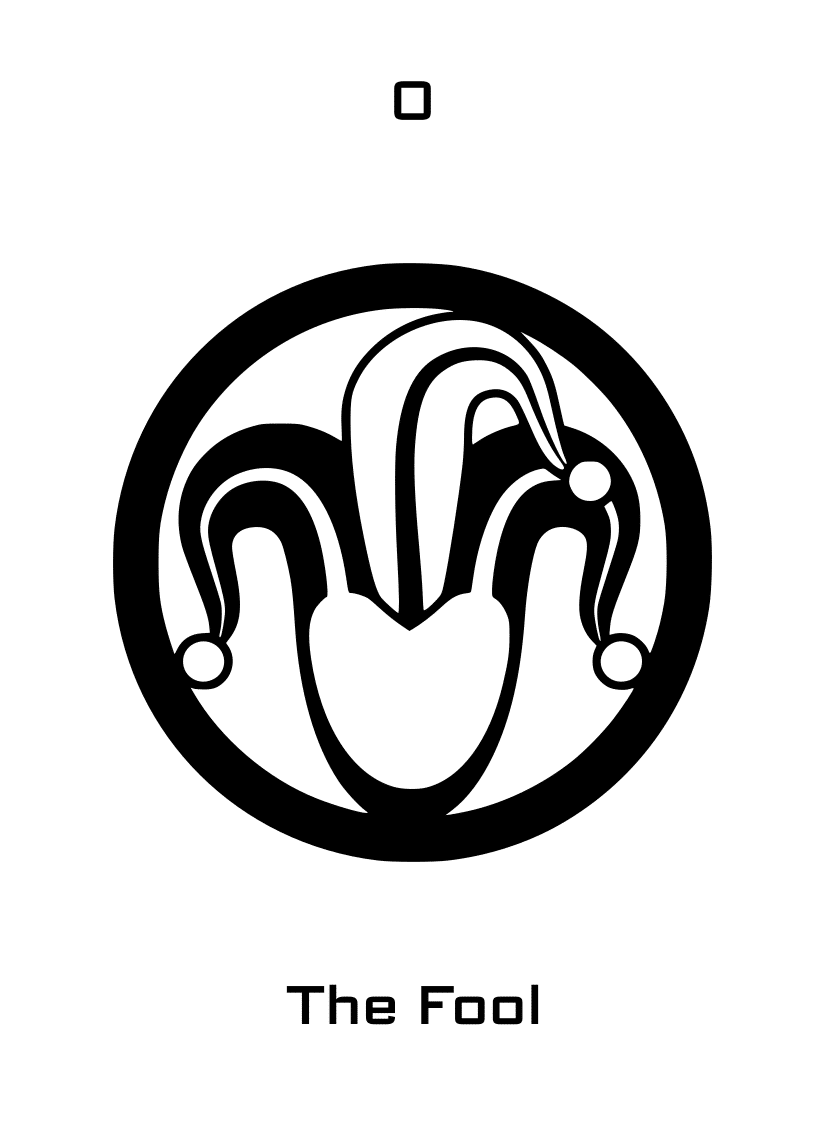
In the Ikonology deck the Fool is a jester's cap: a floppy, many-pointed hat with a bell on each tip, set inside a plain black circle. We chose it because a cap says “fool” faster than any figure could, and because the jester is the one person at court allowed to say true things out loud without losing his head. There is no cliff, no dog and no tiny bag on a stick. Just the hat, which is all the introduction this card needs.
The Magician
Everything you need is already on the table. The trick is picking it up.
The Magician Upright
The Magician is the card of manifestation, resourcefulness, will and inspired action. Where the Fool is the leap, the Magician is the follow-through: the person who looks at a pile of ordinary stuff and sees a finished project. Traditionally this figure stands behind a table holding one hand to the sky and one to the earth, a neat way of saying that ideas only matter once they touch something real. The tools laid out in front of the Magician match the four suits of the deck, which is the card's quiet joke. You've got a sword, a cup, a wand and a coin. What's your excuse?
The Magician Reversed
Reversed, the Magician gets a little shady. The booklet keywords are manipulation, poor planning and untapped talent, and they cover a surprisingly wide range. At the dark end, this is the smooth talker, the sales pitch with a hole in it, the person who uses skill to mislead. Closer to home, it can be your own habit of telling yourself a convenient story.
At the gentler end, the reversed Magician is the talent that never gets used: the novel in the drawer, the business idea you describe to friends but never launch, the trick you've practiced for years and never performed. The tools are on the table and nobody's picking them up. If this card turns up upside down, ask whether you're hiding something, or hiding from something. Then pick one tool and start.
The Icon on The Magician
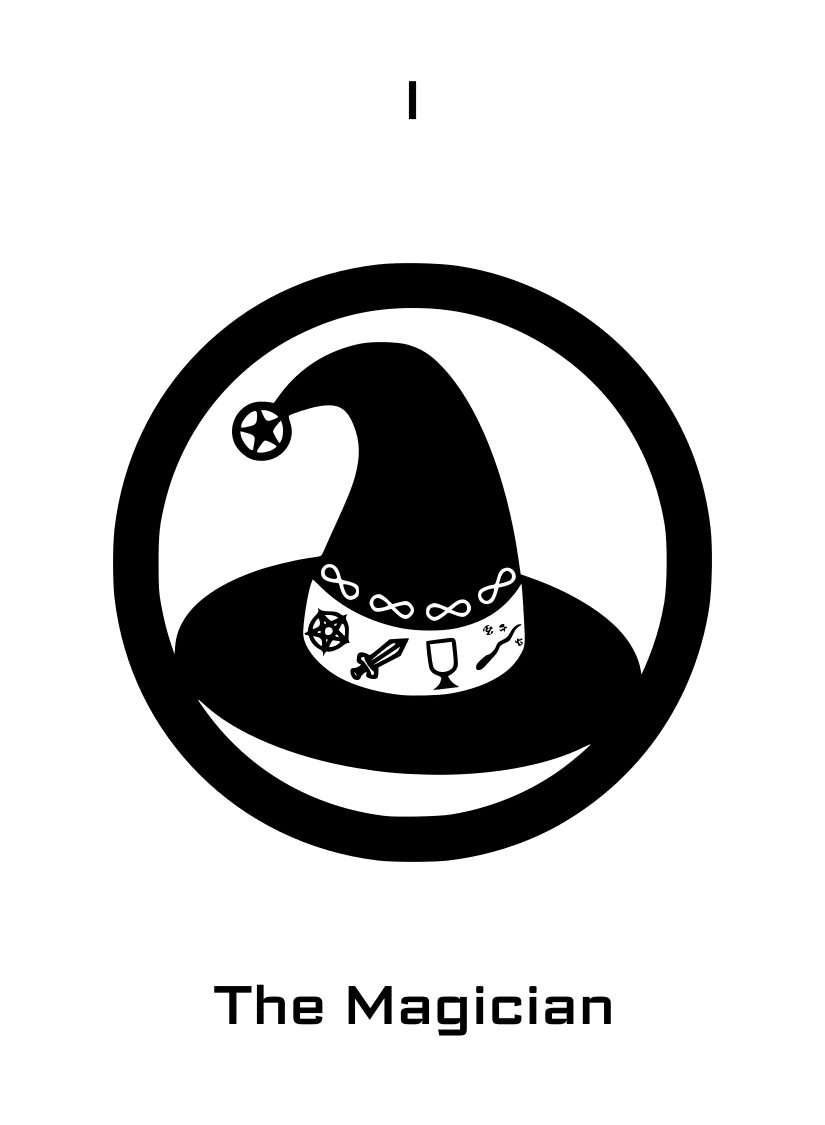
The Ikonology Magician is a wizard's hat: tall, pointed, bent at the tip, with a small star near the point and a band around the base. Look closely at the band and you'll find the whole kit: The sword, cup, wand and pentacle sit there alongside infinity loops, as though the hat were packed for a long trip. We drew a hat rather than a man because a hat is the one thing every cartoon wizard has in common, and it lets the card say “I can make something from nothing” before you've read a word.
The High Priestess
She knows something. She isn't telling. Please stop asking her.
The High Priestess Upright
The High Priestess is the card of intuition, hidden knowledge and the inner voice. She sits between two pillars at the threshold of the unconscious, guarding a scroll she's only half-willing to let you read. Where the Magician acts, she waits. Her power is knowing without proving: the hunch you can't justify, the dream that sticks around all day, the odd feeling a deal is wrong even though every number checks out.
When she appears, the message is usually to slow down and listen. The answer you're hunting for isn't in another spreadsheet or another opinion; it's already somewhere inside you, and it's quieter than the noise you've been feeding it. She also stands for secrets, privacy and things that aren't ready to be said aloud. Not everything needs to be explained, shared or fixed this week. Sit with the question. Write down your dreams. Notice what you notice. The High Priestess rewards patience and has nothing but contempt for people who tap their foot.
The High Priestess Reversed
Reversed, the booklet reads secrets withheld and disconnection from instinct. The High Priestess has gone quiet, or you've stopped hearing her. Maybe you've been overriding your gut so long it has given up arguing, or you've been living on logic and other people's opinions and haven't checked in with yourself in a while.
It can also point to secrets that are doing harm: something kept hidden at work or at home that's growing heavier by the day, or someone else holding back information you need. Ask what you already suspect but haven't admitted. A reversed High Priestess doesn't scold. She just waits, and her wait is longer than your patience, so go find a quiet room.
The Icon on The High Priestess
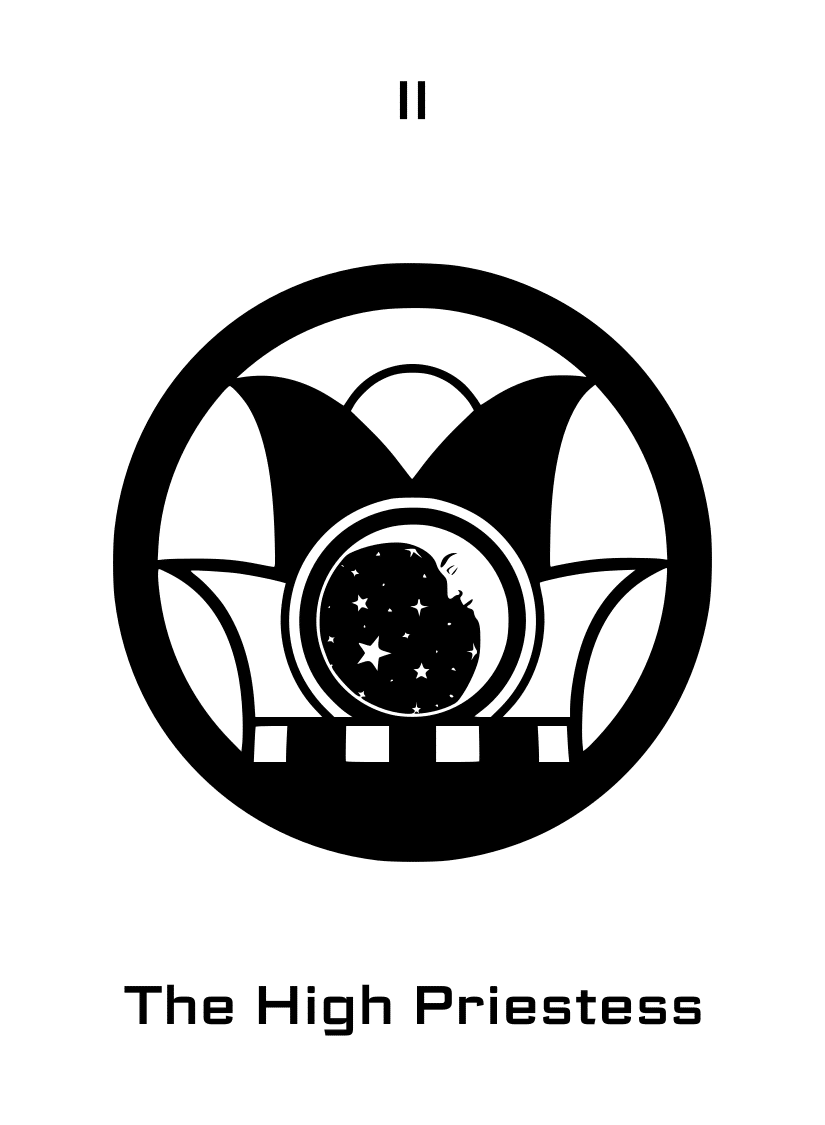
Our High Priestess is a lunar crown: a headdress cradling a glowing orb in which a sleepy crescent moon floats among stars. Beneath it runs a band of black and white tiles, a nod to the paired dark and light pillars of the traditional card. We left the person out. A crown with the moon in it tells you whose seat this is, and the empty chair suits a card all about what isn't said.
The Empress
Abundance, comfort, and somebody insisting you eat something.
The Empress Upright
The Empress is the great provider of the Major Arcana: abundance, nurture, fertility and creative flow. She is the garden in full bloom and the dinner table with an extra chair. Where the High Priestess works in the dark, the Empress works in plain sight, making things grow: children, projects, businesses, friendships, a really good tomato. She represents the senses, the body, beauty and the plain physical pleasure of being alive.
In a reading, the Empress says it's a time of growth and generosity. Creative work flows more easily, relationships deepen, resources appear. She's also a gentle instruction to look after yourself properly: rest, eat well, spend an afternoon outdoors, make something with your hands. The Empress doesn't believe in suffering for art. She believes in sunlight, good soil and a bit of patience, and she'd like you to lie down for a minute.
The Empress Reversed
Reversed, the Empress turns from nurturing to smothering. The booklet gives creative block, dependence and smothering, and each is a kind of growth gone wrong. Creative block is the garden that won't sprout; dependence is the plant that can't stand without a stake; smothering is the gardener who waters too often and drowns the seedlings.
Look at where care has become control, or where you're pouring everything into someone else while your own cup is empty. A reversed Empress can also mean neglecting your own body and comfort, living on coffee and deadlines. Step back, loosen the grip, and let things grow at their own speed. And yes, eat something.
The Icon on The Empress
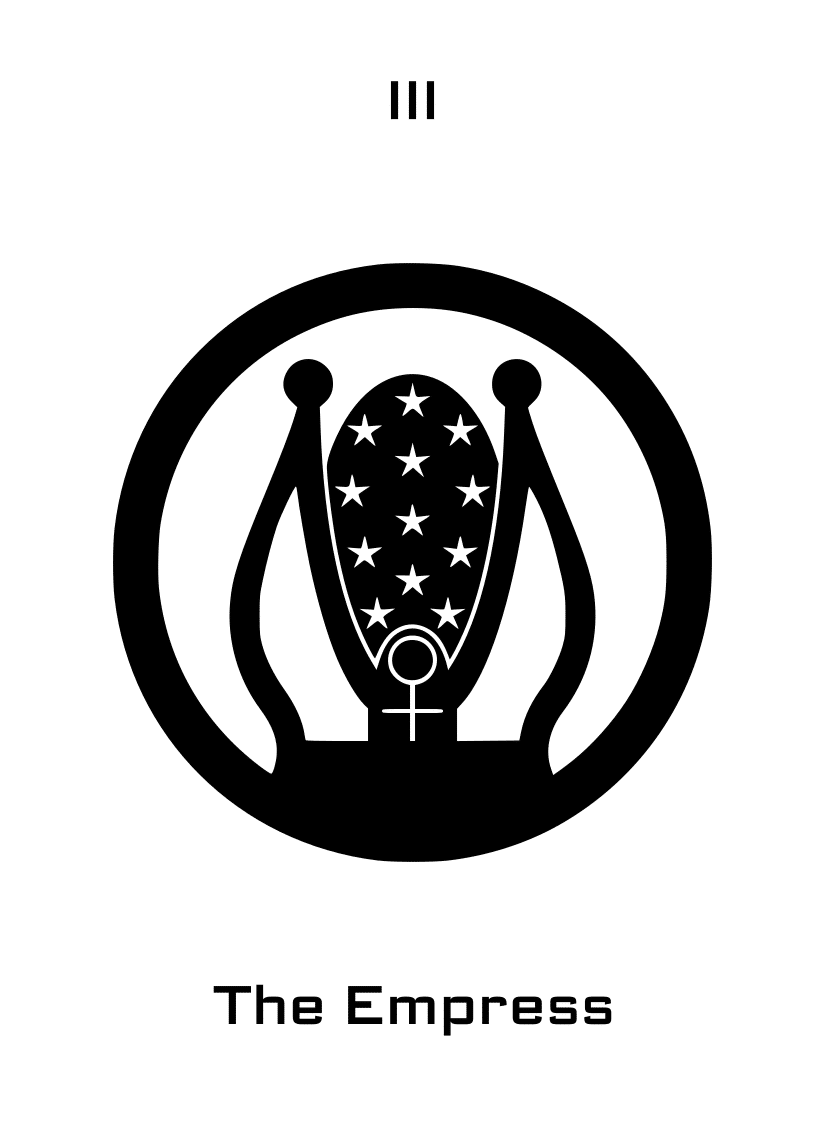
The Ikonology Empress is a crown of stars: an oval packed with five-pointed stars, held up between two curving arms topped with round finials, with the Venus symbol (a circle over a cross) at its base. Venus is the old mark for the feminine, for love and for the planet of beauty, so it needs no caption. The stars nod to the twelve-star crown of the traditional card. The shape is tall, rounded and open-armed, as if the card itself were about to hug you.
The Emperor
Rules, structure, and a very firm opinion about the filing system.
The Emperor Upright
The Emperor is the card of authority, structure, discipline and the father. If the Empress is the garden, he's the fence, the surveyor and the person who actually reads the zoning rules. He builds things that last: laws, companies, routines, stone walls. He stands for order, strategy and taking responsibility, including the unglamorous bits like budgets and deadlines.
When he shows up, the question is usually where you need more structure. A scattered project wants a schedule. A vague goal wants a plan with dates attached. A chaotic week wants a boundary or two. The Emperor can also represent an actual authority figure in your life, such as a boss, parent, mentor or institution, or the part of you that holds yourself accountable. His lesson is that freedom isn't the absence of structure; it's what a good structure makes possible. Build the frame, then paint inside it.
The Emperor Reversed
Reversed, the booklet gives domination, rigidity and control for its own sake. This is the Emperor after the rules have outlived their purpose. The boss who micromanages because he can, the parent who says no because yes would mean a conversation, the inner critic who files every mistake in triplicate.
It can also point to the opposite: no structure at all, no follow-through, a life with the walls knocked out and the roof sagging. Ask whether the rules you're living under still serve a purpose, and whether you're enforcing them or just hiding behind them. A reversed Emperor invites you to stay in charge without being a tyrant. A clipboard is a tool, not a personality.
The Icon on The Emperor
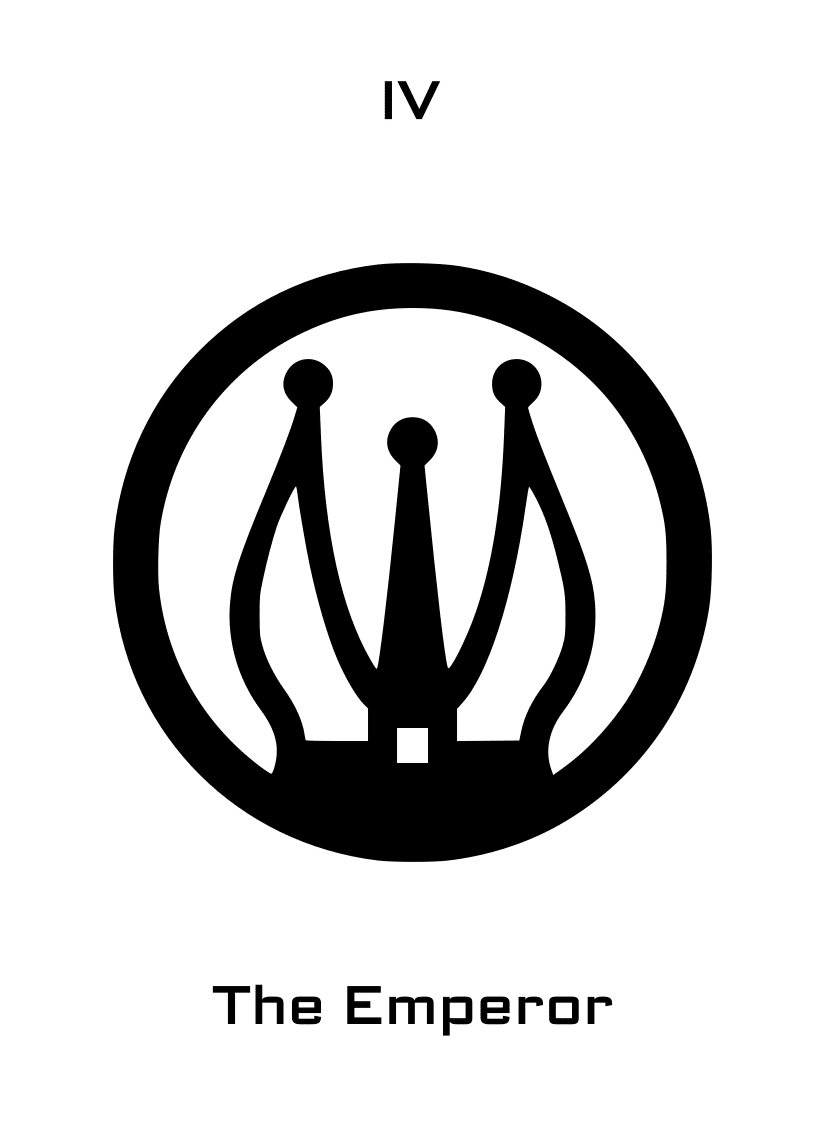
The Emperor is a crown, plain and upright: three points tipped with round balls, rising from a solid base with a small square block at the center. It's the most architectural icon in the deck, close to a drawing of a stone gate. We stripped away throne, beard and armor because a crown alone says “authority” in any language, and because a card about structure ought to look built.
The Hierophant
Tradition, teaching, and the unspoken rules everybody else seems to know.
The Hierophant Upright
The Hierophant (the word means “one who shows sacred things”) is the card of tradition, institutions, shared belief and teaching. He's the teacher at the front of the room, the elder with the rulebook, the ceremony everyone attends because everyone has always attended. Where the Magician improvises, the Hierophant hands down. He represents the value of established knowledge: the apprenticeship, the degree, the family recipe, the proven method.
In a reading, this card often points to learning from someone with experience, joining a group or tradition, or following the established route instead of inventing your own. It can mean marriage, graduation, religious or civic ritual, or simply the comfort of doing something the way it's always been done. There's nothing wrong with a well-worn path; paths get worn because they work. Ask what you could learn from those who came first, and whether you've been too proud to ask.
The Hierophant Reversed
Reversed, the booklet offers rebellion, dogma questioned and new approaches. The Hierophant flips from guardian of the rules to the person who finally asks why we have them. This can be healthy: the rule that made sense in 1962 and now only annoys people, the belief you inherited but never chose, the institution that stopped serving its members years ago.
It can also be rebellion for its own sake, tossing out a good tradition because it came with a lecture. Before you burn the rulebook, read it, and keep the pages that still make sense. A reversed Hierophant invites you to build a personal approach: your own way of doing things, informed by the old ways but not owned by them.
The Icon on The Hierophant
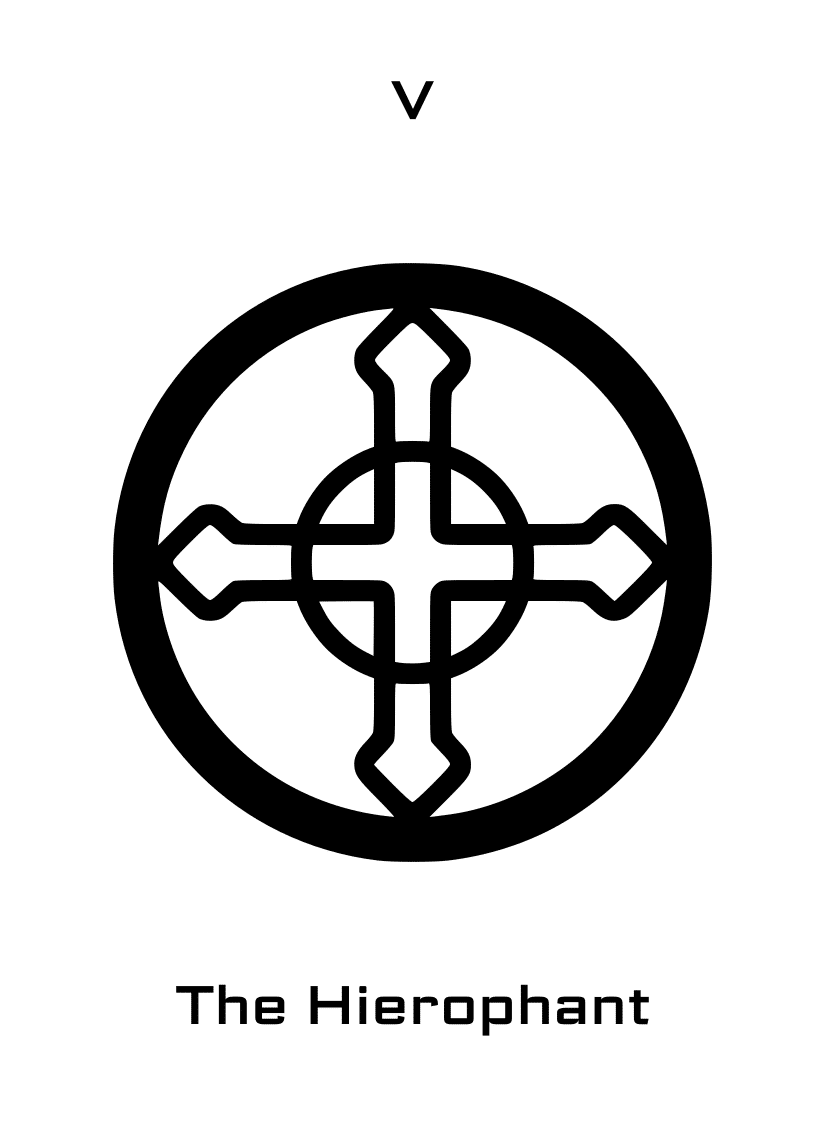
Our Hierophant is a cross within a ring: four arms ending in diamond points, with a circle at the crossing. It's an old, symmetrical, almost architectural mark, the kind you'd find carved above a doorway. We kept it deliberately generic. This card is about tradition in general, not one tradition, so the symbol had to be something many people could recognize as “the thing the community gathers under.”
The Lovers
It's about love, sure. It's also about the hardest thing love asks: choosing.
The Lovers Upright
The Lovers is the card of union, alignment of values and a choice of the heart. Yes, it's about romance, and when it appears beside other love cards, that's usually the first thing it means. But traditionally its core is a decision: two paths, two people, two versions of your life, and a call to pick one with your whole self. It asks whether what you do matches what you believe.
In a reading, the Lovers can describe a deep partnership, a meeting of minds, or a choice that tests your values. Think of a job that pays well but costs you your evenings, a friendship that needs a hard conversation, or a project you believe in more than the safe option. The card isn't about which choice is easier; it's about which is truer. Whatever you choose, choose it with open eyes, because choosing halfway is just a slow way of choosing nothing.
The Lovers Reversed
Reversed, the Lovers show disharmony, misalignment and avoided decisions. Two people want different things and haven't said so. Or you have been circling a choice for so long that the indecision has become the decision. The booklet's phrase, “avoided decision,” is the heart of it: most reversed Lovers readings are about a call someone's been putting off.
It can also point to a mismatch between your actions and your values, such as saying one thing and doing another until you've lost track of which one is you. The cure is rarely dramatic. Name the choice out loud, say what you actually want, and take one small step toward it. Disharmony is not a disaster; it's information.
The Icon on The Lovers
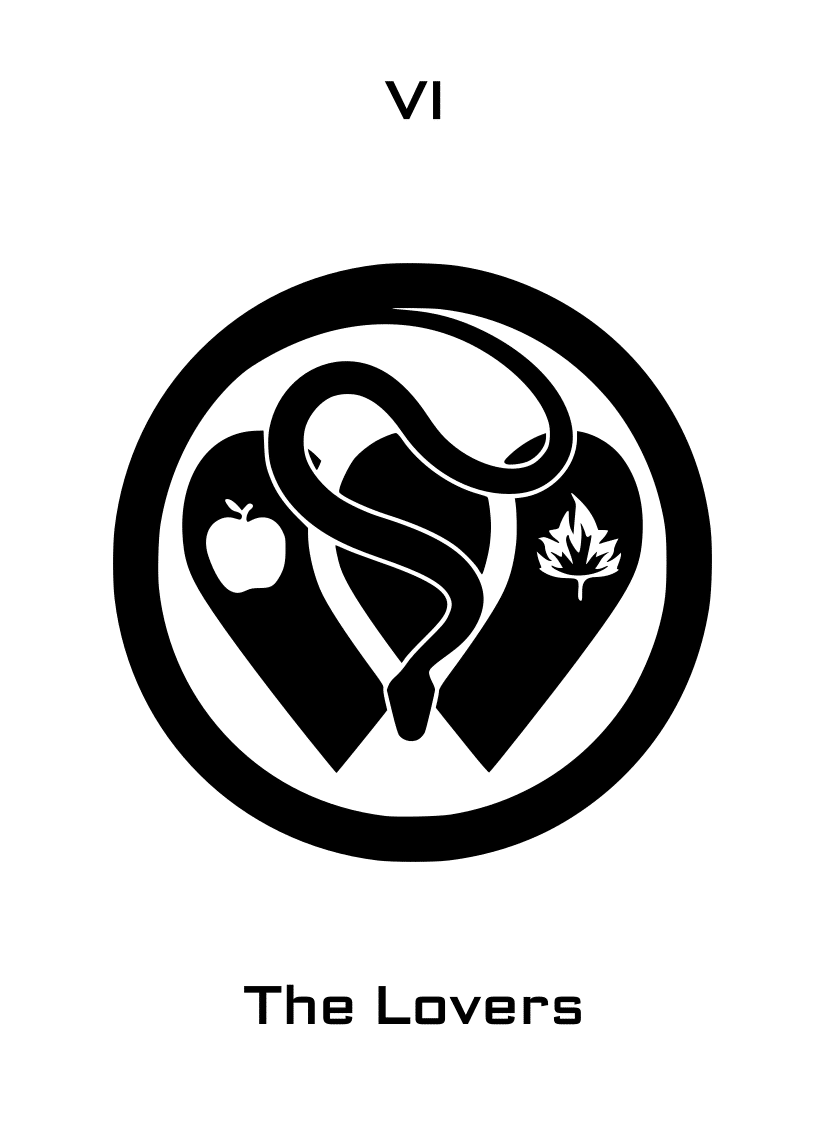
The Ikonology Lovers are two hearts, tilted toward each other, with a serpent winding through the gap. An apple sits in the left heart and a leaf in the right: the old Garden story, boiled down to a symbol. We kept the serpent because the card is as much about temptation and consequence as about affection. No couples in bathrobes, just hearts, a snake and the fruit of a very famous decision.
The Chariot
Two horses pulling in two directions, and one driver who refuses to let either win.
The Chariot Upright
The Chariot is the card of willpower, momentum, focused drive and victory. It's the first card of real motion in the Major Arcana, and the first real test of control: a driver standing in a moving vehicle with no reins, steering two opposing creatures through sheer concentration. The lesson is that success rarely comes from eliminating the opposing forces in your life; it comes from harnessing them and aiming them the same way.
When it shows up, you're being asked to commit, push forward and keep your eyes on the road. It's a good card for exams, competitions, long drives, job pursuits and any project with a finish line. You may be pulled between duty and desire, or between fear and ambition, but the Chariot says you can hold both and still move forward. Pick a direction, then give it everything. Hesitation is the only real way to lose this one.
The Chariot Reversed
Reversed, the booklet gives loss of direction, opposition and scattered force. The driver has dropped the reins, and the horses are doing their own thing. Energy goes everywhere at once: six projects, nothing finished, plenty of effort, no arrival. Or external forces, such as other people, bad timing or simple bad luck, are blocking the road.
Ask where you're spending drive without a destination. A reversed Chariot isn't a failure; it's an invitation to stop, pick one target, and get everything pointed at it. If the opposition is real, plan around it rather than through it. You haven't run out of fuel; you just need to settle which way is forward.
The Icon on The Chariot
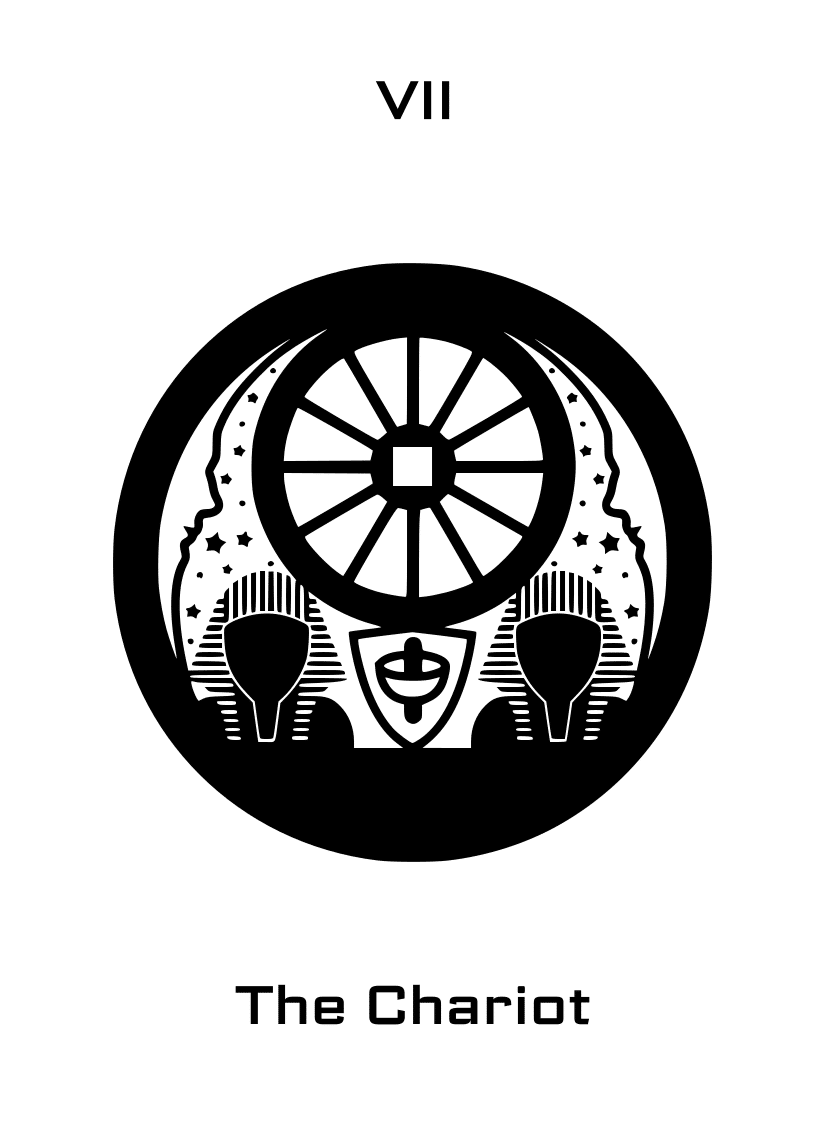
The Chariot is a wheel above a pair of sphinx-like figures and a shield, set against a starry sky. The spoked wheel stands in for the vehicle and gives the card its sense of motion; the two sphinxes are the dark and light forces that must be driven together; the shield in the middle represents the driver. We replaced the cart, horses and armored figure with three simple parts, each of which does a job. It's the busiest icon in the deck, and so is a chariot.
Strength
The loudest voice in the room is not the strongest. The lion knows this.
Strength Upright
Strength is the card of inner strength, persuasion, patience and compassion. Don't be fooled by the muscle on the cover. The traditional image shows a calm figure gently closing the jaws of a lion, and the point is that the lion isn't being beaten. It's being befriended. Real strength in the tarot is the kind that doesn't need to shout: the steady hand, the quiet “no,” the ability to stay kind when anger would be easier.
In a reading, Strength asks you to meet a difficult situation with patience instead of force. It might be a temper, a deadline, a difficult relative or a fear you've been dodging. Brute effort will only make the lion roar louder. Courage, in this card, means staying soft in the face of something big, and trusting that gentleness can be a very firm kind of power. It's also a card of self-mastery: not suppressing your wilder instincts, but learning to work with them.
Strength Reversed
Reversed, the booklet reads self-doubt, raw emotion and force over finesse. The lion is loose. Either the temper has run away with you, or you've lost faith in your own ability to handle the situation. You may be pushing too hard where a lighter touch would do, or shrinking when you should stand firm.
It's worth asking which side of the lion you're feeling. Is it the roar (anger, impatience, a need to win) or the cower (doubt, exhaustion, a belief that you're not up to it)? Both are fixable. Breathe, slow down, and treat yourself with the same patience you'd offer a nervous animal. Strength isn't something you either have or lack. It's something you practice.
The Strength Icon
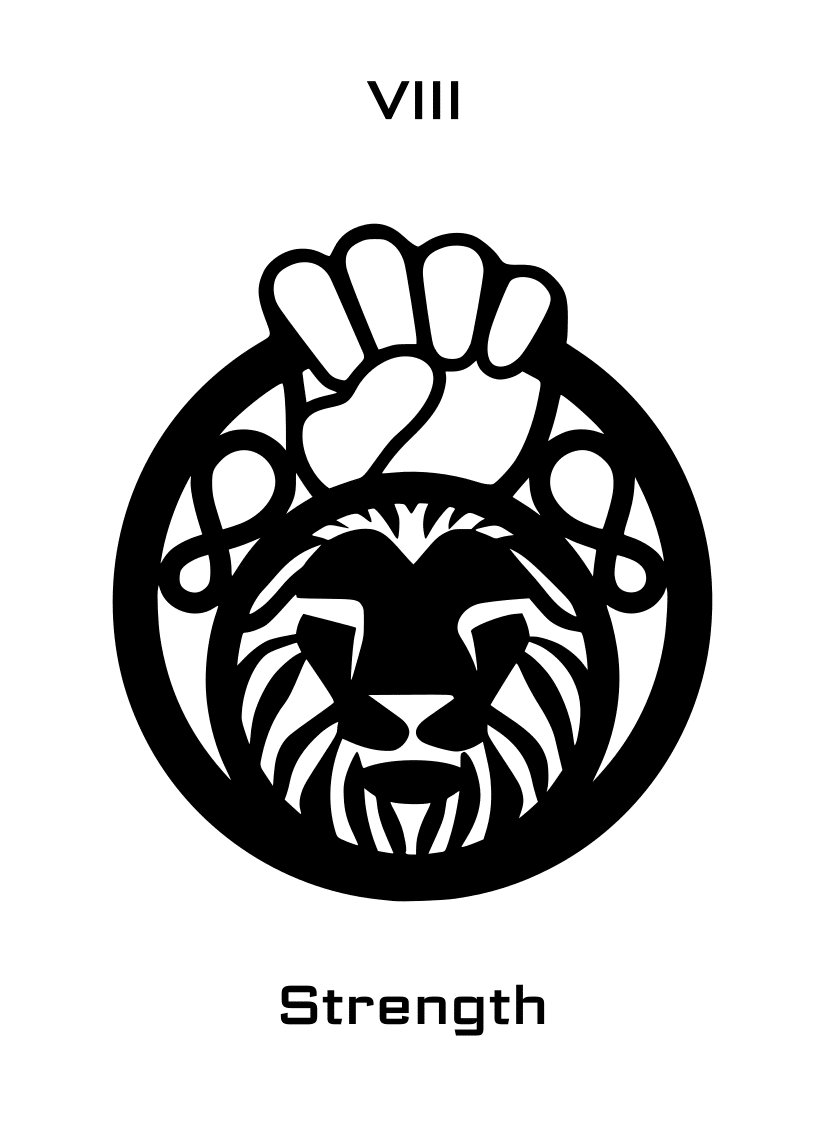
The Ikonology Strength is a lion's face with a raised fist above it, and two infinity loops curling out at the sides. The fist is the part we worried over, because it looks like a protest sign, and this card is the opposite of a brawl. We kept it because Strength is about power under control: a closed fist, a gentle lion, and the loops that tell you this takes a lifetime of practice. The lion's calm face tells you who's really in charge.
The Hermit
Sometimes the best conversation is the one you have alone, with the phone off.
The Hermit Upright
The Hermit is the card of solitude, introspection and guidance sought or given. He's the one who walks away from the crowd with a lantern, not because he dislikes people, but because the answer he needs isn't in the noise. He represents the deliberate retreat: a sabbatical, a weekend alone, a long walk, a project you do in private before showing anyone.
In a reading, the Hermit says it's time to look inward and think things through, probably away from other people's opinions. It can also be a teacher or mentor, someone who's walked this path before and will hold the light for you, or the role you're being asked to play for someone else. The lantern lights only a few steps ahead. That's all the Hermit offers, and it's enough, because wisdom is rarely a floodlight. It's one careful step, and then the next one.
The Hermit Reversed
Reversed, the booklet gives isolation, withdrawal and refusing counsel. Solitude has tipped into loneliness, or you've stopped answering the phone because it's easier than being known. It can also mean ignoring the good advice from people who care, or stubbornly walking in the dark when a friend is standing there holding a perfectly good torch.
On the flip side, a reversed Hermit may suggest you've had enough time alone and it's time to come back and join the world. Check which one applies. If you've been hiding, take one small step back toward people. If you've been refusing help, take it. Even Hermits agree that the lantern works better when two people hold it.
The Icon on The Hermit
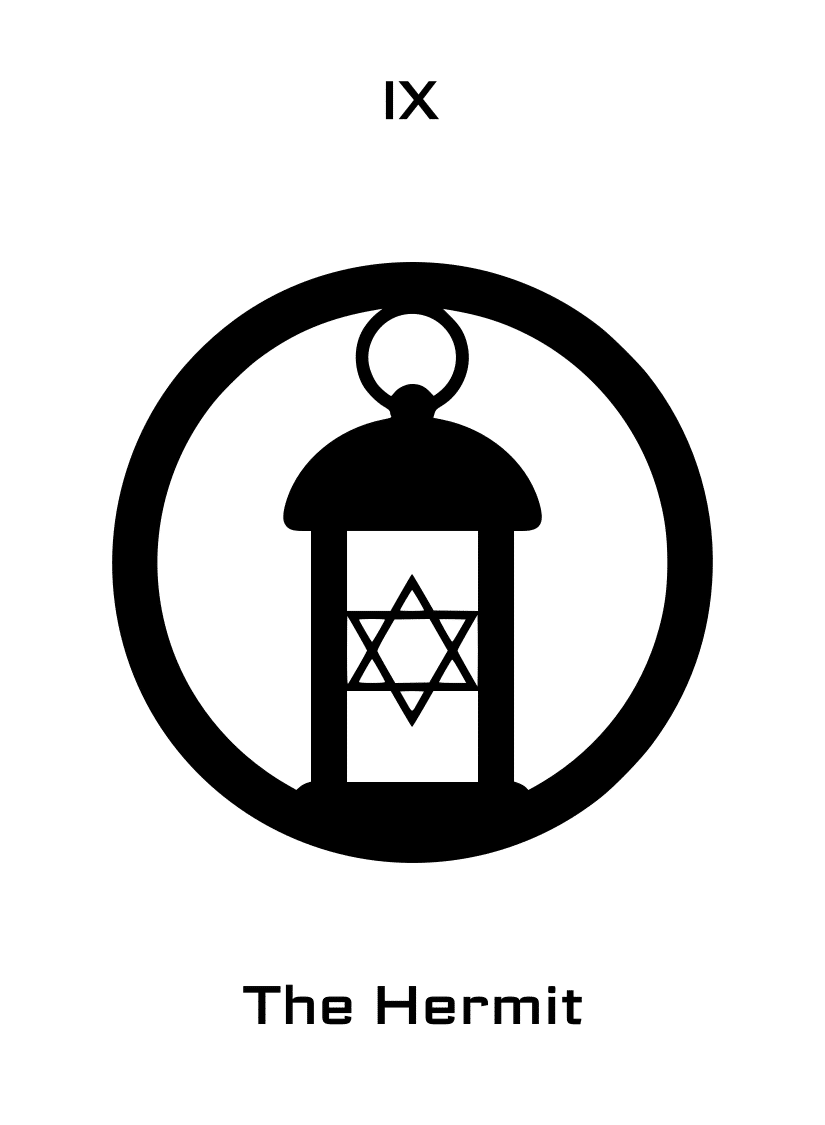
The Hermit is a lantern with a six-pointed star glowing inside it, hanging from a ring. The lantern replaces the old man, the staff and the mountain with the one object that explains everything: a small light carried alone through the dark. The star inside is a quiet nod to hidden knowledge, the wisdom the light is protecting. You won't find a beard anywhere on this card, and the Hermit wouldn't care.
The Wheel of Fortune
What goes up must come down. What comes down will, in time, go back up.
The Wheel of Fortune Upright
The Wheel of Fortune is the card of cycles, turning points, fate and momentum shifts. It's the tarot's reminder that nothing stays still: seasons turn, markets move, luck changes sides. Where other cards ask what you will do, the Wheel asks what is happening around you, and what you can learn from the pattern. It brings news of change, and that change is rarely something you picked.
In a reading, it usually signals a turning point. A run of bad luck may be about to end, or a long streak of good fortune may be ready to shift. Either way, the card's advice is to stay flexible. Don't cling to the top of the wheel, and don't give up at the bottom. The Wheel also invites you to step back and see the bigger pattern: where you've been, where this chapter fits, and which parts of your life are simply cycling and which you can actually influence. It's a card of humility and hope in equal parts.
The Wheel of Fortune Reversed
Reversed, the booklet reads resistance to change, bad timing and a cycle repeated. The wheel has jammed, or you're digging in your heels against a turn that's coming whether you like it or not. It can describe a bad stretch that feels endless, a pattern that keeps returning (same mistake, new year) or a plan thrown off by timing you can't control.
The advice is to figure out which part of the cycle belongs to you. Patterns repeat until we spot the lesson, so ask what keeps coming round, and what you'd do differently this time. If it's pure bad timing, wait and be patient. The wheel keeps turning, and the reversed card promises only that it hasn't stopped, merely sticking. Give it a nudge.
The Icon on The Wheel of Fortune
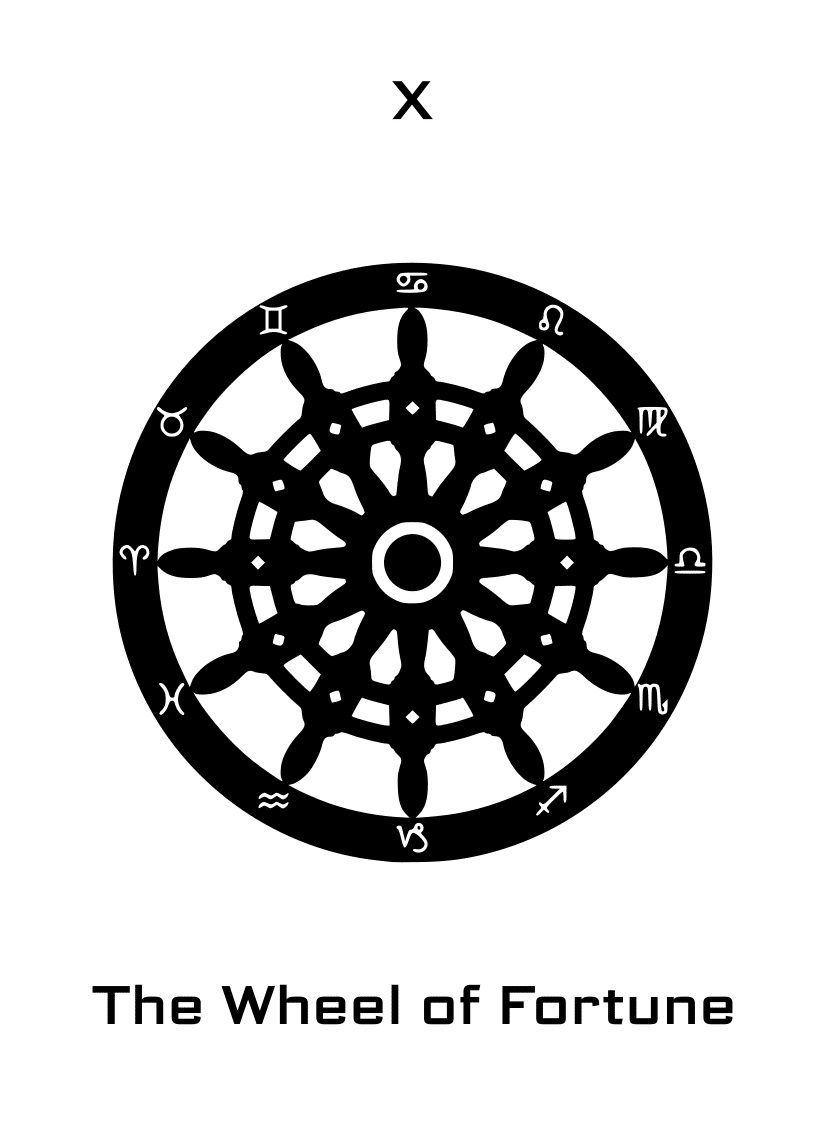
Our Wheel of Fortune is a spoked wheel, a bit like a ship's helm, wrapped in a ring of the twelve zodiac signs. We chose the zodiac because it's the oldest cycle humans ever charted, a literal turning of the sky. The wheel's many spokes suggest a lot of moving parts, and the ring of signs reminds you that fate, in the old way of thinking, was written in the stars. The same ring appears on The Star, which is no accident: sky above, wheel below.
Justice
Every action has a consequence. This card is the receipt.
Justice Upright
Justice is the card of fairness, cause and effect, accountability and truth. It's the scales and the sword: the weighing of evidence and the cut of the decision. Traditionally it stands for legal matters, contracts, honest dealings and the principle that what you put into the world finds its way back to you. It isn't concerned with who's popular or who tells the better story. It asks only what is true, and what follows from it.
When Justice appears, the advice is to be honest, fair and clear-eyed. Own your part in the situation. Read the paperwork. Make the decision based on facts rather than feelings (though feelings are a fact too, so weigh them). It can also mean that something unresolved is about to be settled, and that the outcome will be proportionate to what you've done. For anyone who has acted with integrity, this is a reassuring card. For anyone who hasn't, it's a gentle but firm reminder that the bill is coming.
Justice Reversed
Reversed, the booklet lists bias, dishonesty and consequences evaded. The scales are tipped. Maybe someone is cheating, you're seeing only one side of the story, or you've been dodging responsibility for something you did. It can also describe a situation where the outcome simply isn't fair: a decision made on the wrong evidence, a promise not kept, a rule applied to some and not to others.
Ask where you're bending the truth, even slightly, and where someone else might be doing it to you. A reversed Justice is less a verdict than a warning to get your facts straight before the real one arrives. Document things, tell the truth early, and don't expect the story to survive if it's built on a shortcut.
The Justice Icon
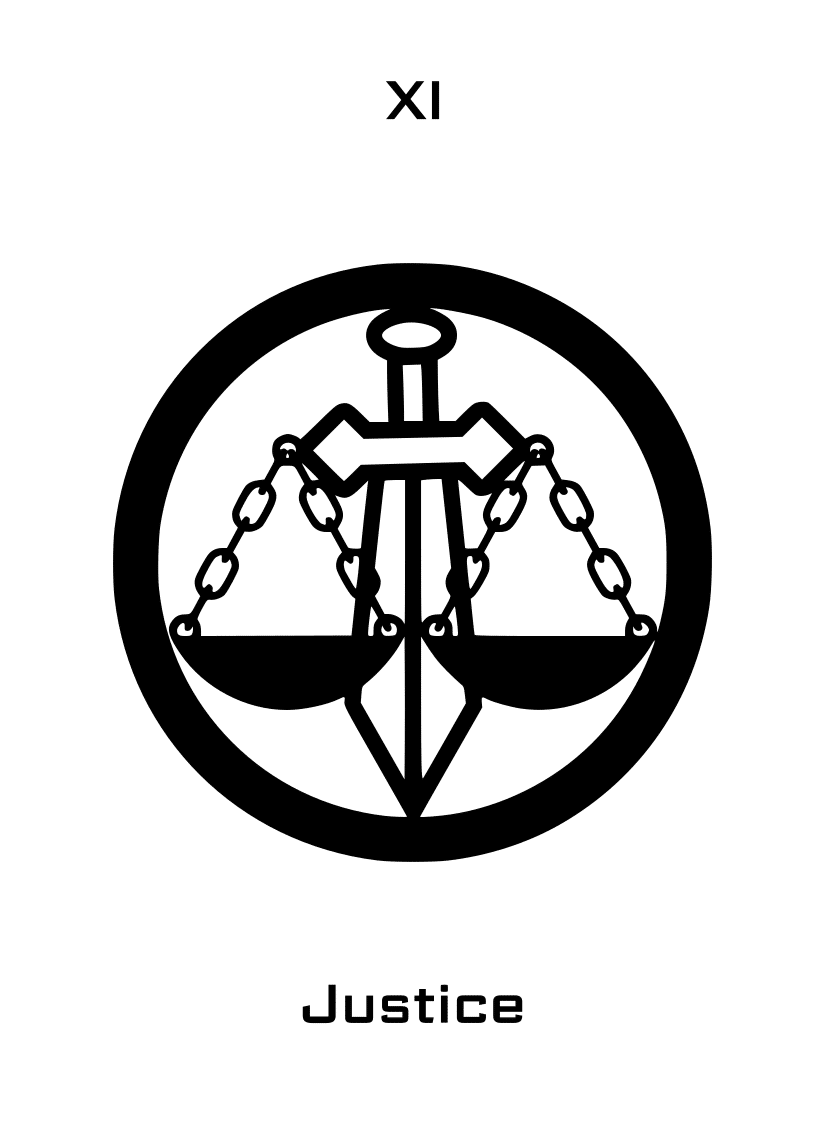
The Ikonology Justice is a sword standing upright, with a pair of scales hanging from the crossguard on little chains. It's a tidy picture: the blade for the decision, the pans for the weighing, and the whole thing balanced on a single point. We left out the robed judge and the throne because the tools say it all. Scales alone only weigh, and a sword alone only cuts, so Justice needs both.
The Hanged Man
Stuck? Perhaps. Or perhaps you're finally seeing it from a new angle.
The Hanged Man Upright
The Hanged Man is the card of pause, surrender and a reversed perspective. Traditionally he hangs upside down from a tree, calm, with a halo, as though this were exactly the spot he meant to be. That's the hint. He isn't being punished. He has chosen to stop struggling and let the situation turn him around so that he sees it differently. He represents the wisdom of waiting, of letting go of the need to control and of seeing the world from a new angle.
In a reading, the Hanged Man says to stop pushing. A delay that feels like a setback may be a gift, giving you time to rethink the plan or find what you missed. It may involve a sacrifice: a short-term loss for a long-term gain, or letting go of an old idea to make room for a better one. Resist the urge to force an answer. Sit in the discomfort a while longer and see what changes when you look from the other side.
The Hanged Man Reversed
Reversed, the booklet gives stalling, resistance and delay without purpose. The pause that was meant to produce insight has turned into mere procrastination. You're hanging around, waiting for something to happen, and it won't until you move. Or you're resisting a necessary surrender, holding on to a position long after it stopped serving you.
Ask whether your pause has a purpose. If you're waiting for clarity, good. If you're waiting because you're scared, that's a different matter. A reversed Hanged Man is a nudge to decide to either let go properly or to get on with it. Either is allowed. Dangling forever is the one option that isn't.
The Icon on The Hanged Man
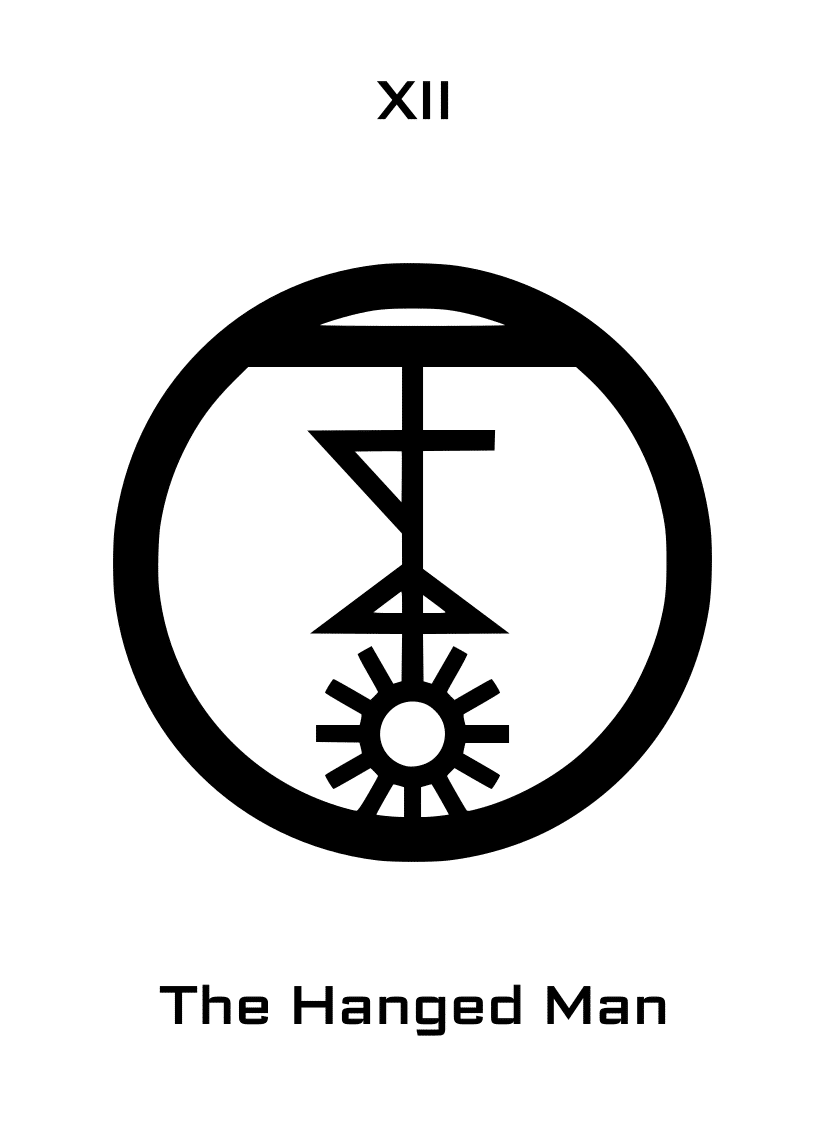
The Hanged Man is a stack of symbols hanging from a crossbar at the top of the circle: a small cross, a triangle and, at the bottom, a radiant sun. Together they form a plumb line, a chain of ideas suspended and held in place. We swapped the man for symbols because the card is about perspective, and a symbol is something you can look at from any angle. It's also the one icon you could happily turn upside down.
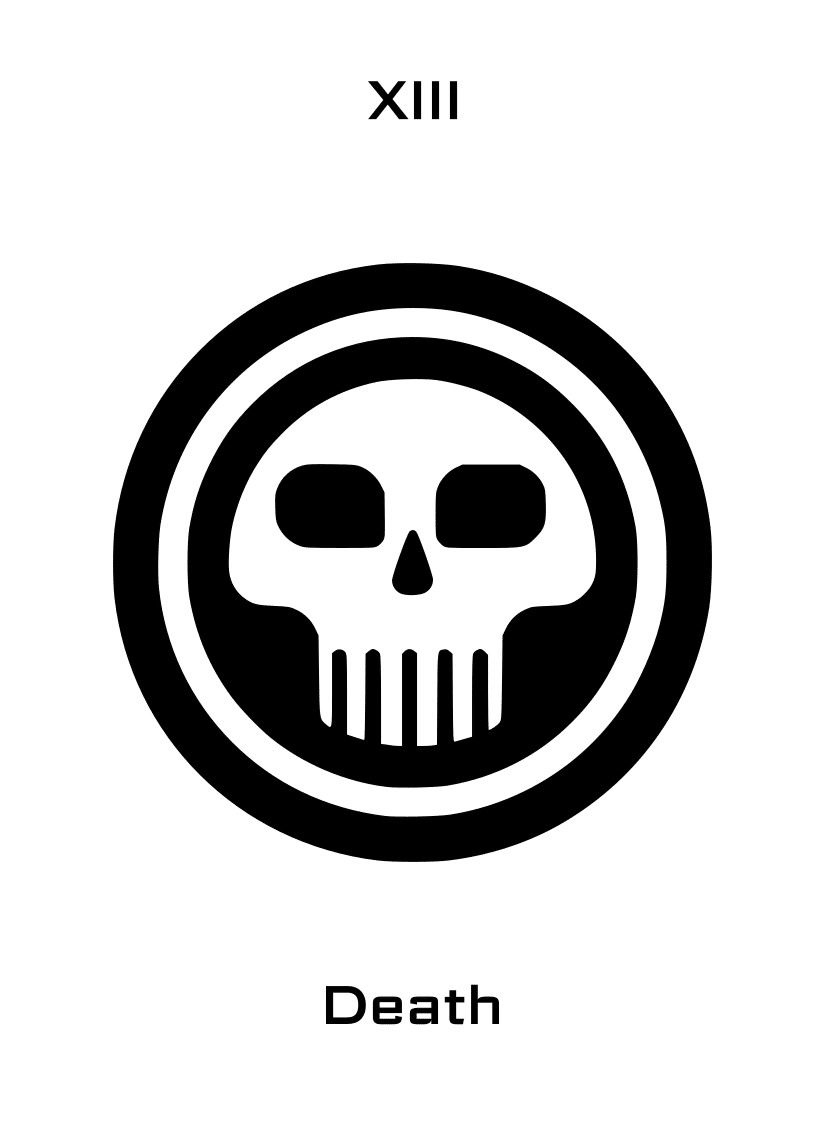
Death
Take a deep breath. No one is dying. Probably.
Death Upright
Death is the card of endings, transformation and clearing the ground. It almost never means physical death. It's the end of a chapter: a job, a relationship, a belief, a phase of life. It stands for the necessary kind of loss, the kind that makes room. Nothing new can grow in a field choked with last year's weeds, and Death is the card that shows up with the shears.
In a reading, it says something is finishing, and the wise move is to let it. Fighting an ending usually just prolongs the discomfort. The card is also about renewal. After the ending comes the clearing, and after the clearing, space for something fresh. If you've been dreading a change, Death may be telling you that the worst part is the waiting. It's a serious card, but not a grim one. It's a card for people willing to let go of what no longer works so that something better can start.
Death Reversed
Reversed, the booklet reads clinging on, stagnation and a change refused. The ending is due and you're holding the door shut. Perhaps you're staying in a job that's over, in a relationship that has run its course, or in a version of yourself that's too small. Stagnation is the quiet cost: things stay the same, and a low-level dread settles in.
The reversed card asks what you're refusing to release, and what you're afraid will happen if you do. Often the fear is bigger than the change. You don't have to leap, but you can start by acknowledging that the chapter is over. After that, you can begin writing the next one.
The Death Icon
Death is a skull set inside a double ring, bold and blunt. It's the one icon in the deck that looks like what it says, and we like the honesty. The double ring is a quiet touch: one circle for life, one for what comes next. The skull looks relaxed, almost smiling, because in the tarot Death is less a villain than a stage manager, the one who clears the set so the next scene can begin.
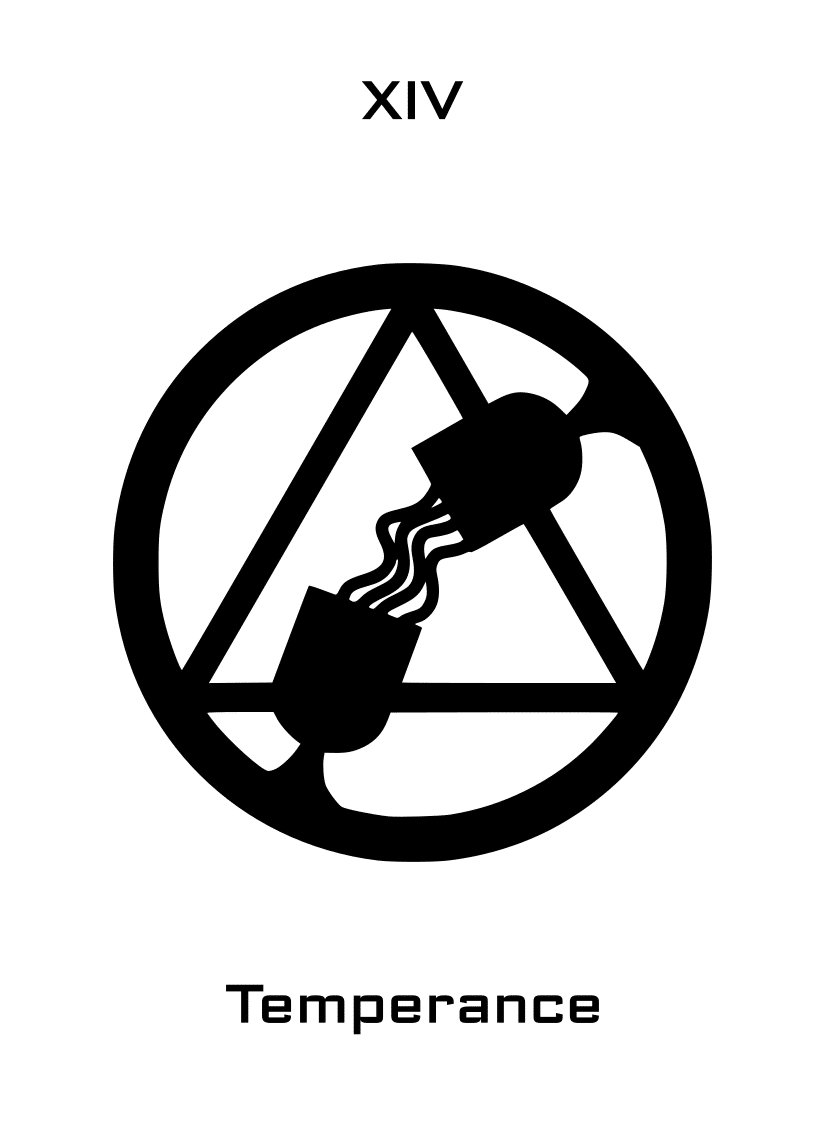
Temperance
Not too much, not too little. A little of this, a little of that. Patience.
Temperance Upright
Temperance is the card of balance, moderation and patient blending. The traditional image shows an angel pouring water between two cups, one flowing into the other without spilling a drop. It's the art of mixing opposites into something that works: effort and rest, work and play, caution and risk. It represents harmony reached through steady, deliberate practice, not a sudden fix.
In a reading, Temperance advises you to slow down and find the middle path. Avoid extremes, whether that's overworking or overindulging. It can also point to healing, to recovery and to the slow mixing of two different things: two cultures, two skills, two people learning to live together. Success here is a matter of proportion. A drop too much of anything and the recipe fails, so take your time and taste as you go. Patience isn't a delay on the way to the result; with this card, it's the method.
Temperance Reversed
Reversed, the booklet gives excess, imbalance and impatience. The mixture has gone wrong. Too much work, too much indulgence, too much of one ingredient and not enough of another. Impatience is the other key word: the urge to rush the blend, crank the heat and force a result that really needs time to settle.
Look at where your life is lopsided. Which area is getting all the attention, and which is quietly starving? The reversed card isn't asking for perfection, just a small adjustment: a little more rest, a little less caffeine, a little more patience with a person or process that isn't going to be rushed. Pour slowly.
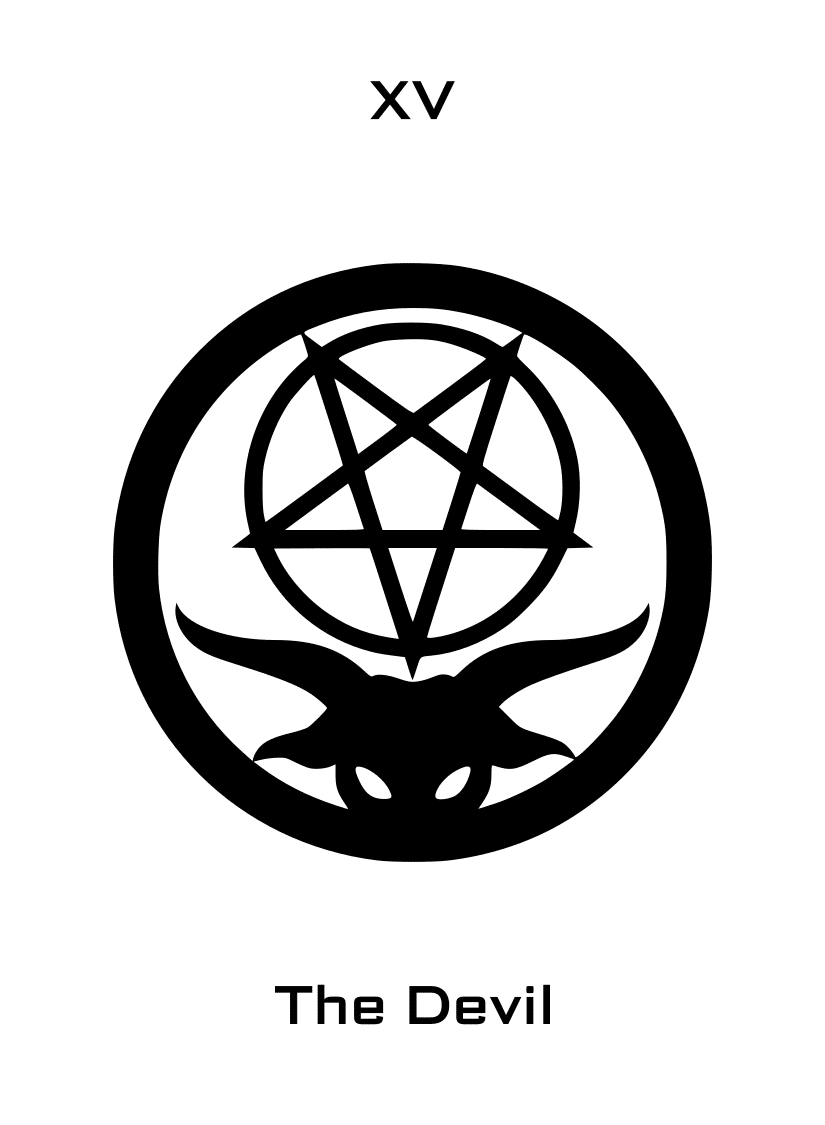
The Devil
The chains are looser than they look. Try them on and see.
The Devil Upright
The Devil is the card of attachment, appetite and self-imposed bondage. It looks fearsome, but the traditional image holds the clue: the two figures at the feet of the horned beast wear chains that could be lifted right off. The Devil represents the things that hold us, such as habits, addictions, unhealthy relationships and stories we tell ourselves about what we can't change, and how much of the grip is our own.
In a reading, this card isn't a prediction of evil. It's an invitation to look at what you're hooked on. It might be a literal habit, a bad job you've been keeping out of fear, a person who only brings out the worst in you, or an appetite for drama. The Devil also governs desire, ambition and the physical world, so it isn't all warning; there's a healthy side in pleasure, energy and wanting things. The question is whether you're choosing it or it's choosing you.
The Devil Reversed
Reversed, the booklet gives release, detachment and reclaiming power. The chains come off. You see the grip for what it is and begin to loosen it. This is one of the more hopeful reversals in the deck: a break from an unhealthy pattern, a first honest conversation about a habit, the moment you realize the lock was never locked.
Recovery is rarely instant, so be gentle with yourself. The card suggests the work is underway and the power is coming back to you. Take support where you can find it, and don't expect a clean break. A reversed Devil says you've seen the chain. Keep going.
The Icon on The Devil
Our Devil is an inverted pentagram floating over a horned goat's head, with the goat's face cropped at the bottom of the circle. It's the most ominous icon in the deck, and on purpose. The goat comes from the old Baphomet imagery, and the upside-down star is the classic sign of matter ruling spirit. We kept it dramatic because the card's message depends on the scare: look how frightening this appears, then notice the ring around it is a plain circle. You can step out any time.
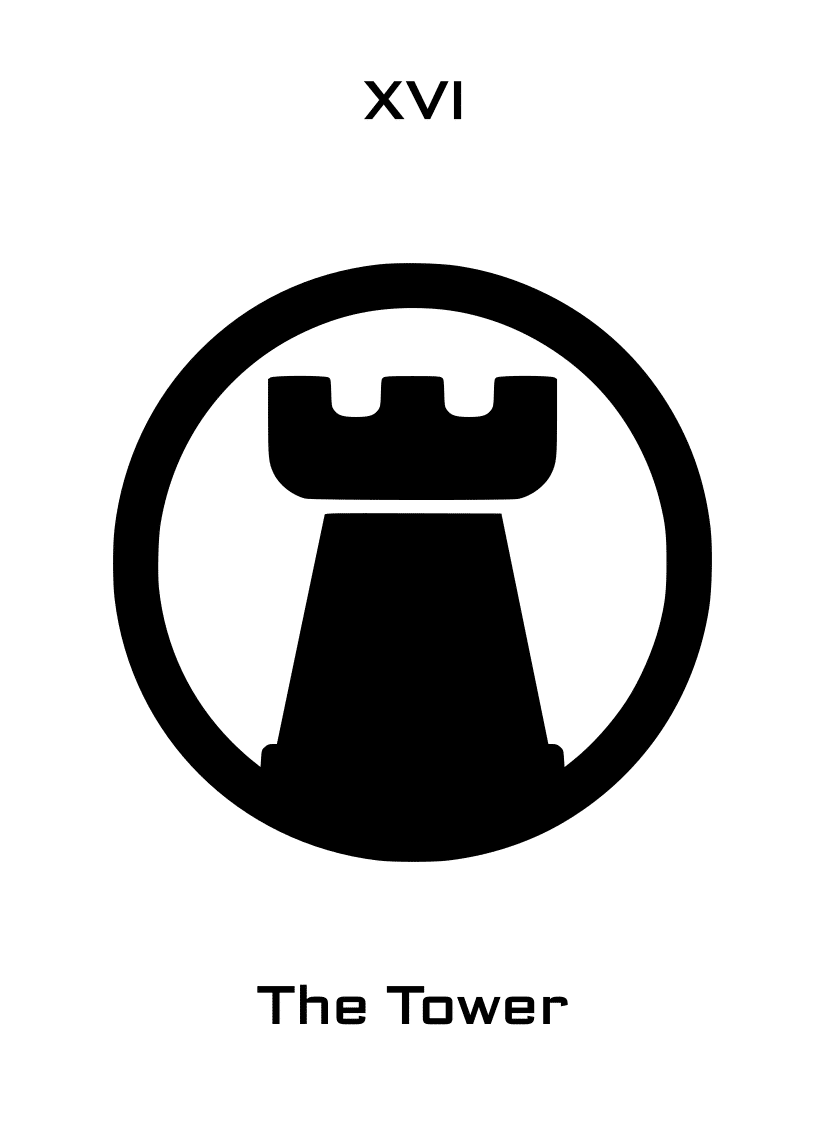
The Tower
Nobody sees this card coming. That is rather the point.
The Tower Upright
The Tower is the card of sudden upheaval, revelation and structures falling. In the traditional picture, lightning strikes a tall building and people tumble from its windows. It looks catastrophic because it is: something you built, believed in or depended on is suddenly, sometimes spectacularly, knocked down. The shock is real, but so is the strange relief that follows. The Tower tends to hit things that were built on shaky ground, and it hits them hard.
In a reading, it can mean a job loss, a breakup, a collapsed plan or a truth that blows up a comfortable story. It can also mean a revelation: the moment you see what was really going on. Nobody enjoys it, and nobody should pretend to. But the Tower clears away what was false and makes room for something that can actually stand. Ask what, in your life, has been propped up with excuses and wishful thinking. When the dust settles, you'll see which parts of the foundation were worth keeping.
The Tower Reversed
Reversed, the booklet reads disaster averted, fear of change and slow collapse. There are three versions. In the best, you spot the crack early and fix it, so the lightning never lands. In the second, you're so afraid of the upheaval that you refuse to touch anything, which only delays it. In the third, the collapse isn't sudden at all; the structure is eroding bit by bit, and nobody mentions it.
A reversed Tower asks you to be honest about what's cracking and to deal with it on your own terms, before it deals with you. A planned renovation is nearly always gentler than a surprise demolition. It's less dramatic and takes more courage. Start with the wobbliest wall.
The Icon on The Tower
The Tower is a single crenellated tower, drawn as a solid black silhouette. It looks like a rook from a chess set, which is a happy accident, since the rook is the piece that moves in straight lines right up until it suddenly captures something. We left out the lightning, the flames and the falling people. A tower standing quietly is somehow more unsettling than one that's already on fire. You're meant to wonder what's about to happen.
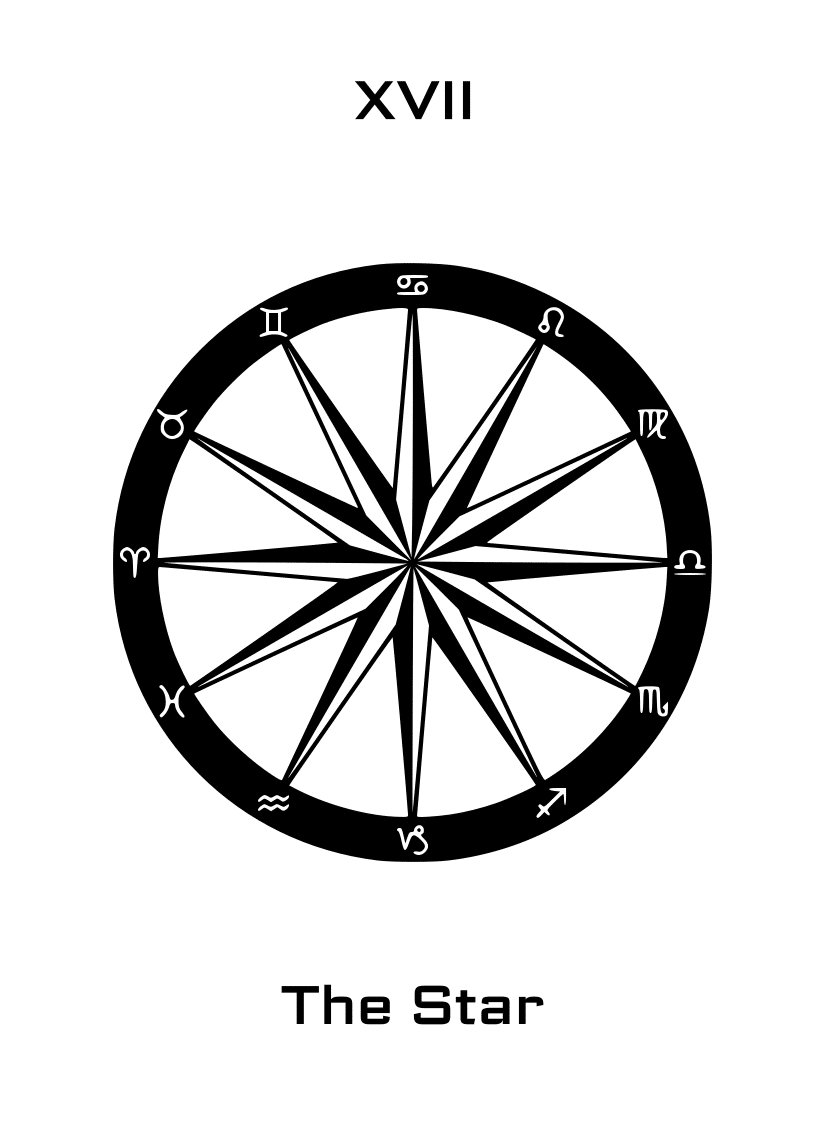
The Star
The storm passed. Look up. There's still a sky.
The Star Upright
The Star is the card of hope, renewal, faith restored and calm after the storm. It comes right after the Tower for a reason. When the collapse is over and the dust has settled, the Star appears as the first quiet breath, the sense that perhaps things aren't ruined after all. The traditional card shows a figure kneeling by water under a sky full of stars, giving back to the earth without fuss. It's generous, gentle and unhurried.
In a reading, the Star brings healing. It promises that the difficult chapter is easing and your energy is returning. It's a card of inspiration and long-term vision, of believing in a future you can't fully see yet. It also invites you to take care of yourself and others: rest, restore, share what you have. Unlike the flashy cards, the Star works in the background. Its promise is modest and entirely trustworthy. Keep going. The light you're following is a real one, even if it's a long way off.
The Star Reversed
Reversed, the booklet gives despair, disconnection and faith lost. The sky has clouded over. You may be worn out by a long stretch of difficulty, with nothing left to hope on, or you've lost touch with the things that used to inspire you. It can also mean the hope you do have is pinned on something unrealistic, and you're drifting.
The reversed Star isn't a sentence; it's a request for rest. Look after the basics first: sleep, food, a friend who'll just listen. Then try one small, achievable thing that points toward the future, even a modest one. The stars haven't gone anywhere. The clouds are just in the way, and clouds move.
The Icon on The Star
The Star is a many-pointed star, drawn like the compass rose on an old map, ringed by the twelve signs of the zodiac. A compass is what you use to find your way when the road disappears, and the sky is where sailors looked for centuries to get home. It's the same ring as on the Wheel of Fortune, which makes sense: the Wheel is fate turning, and the Star is what's still shining when the turn is done. We didn't draw a kneeling figure. The star is doing the pouring.
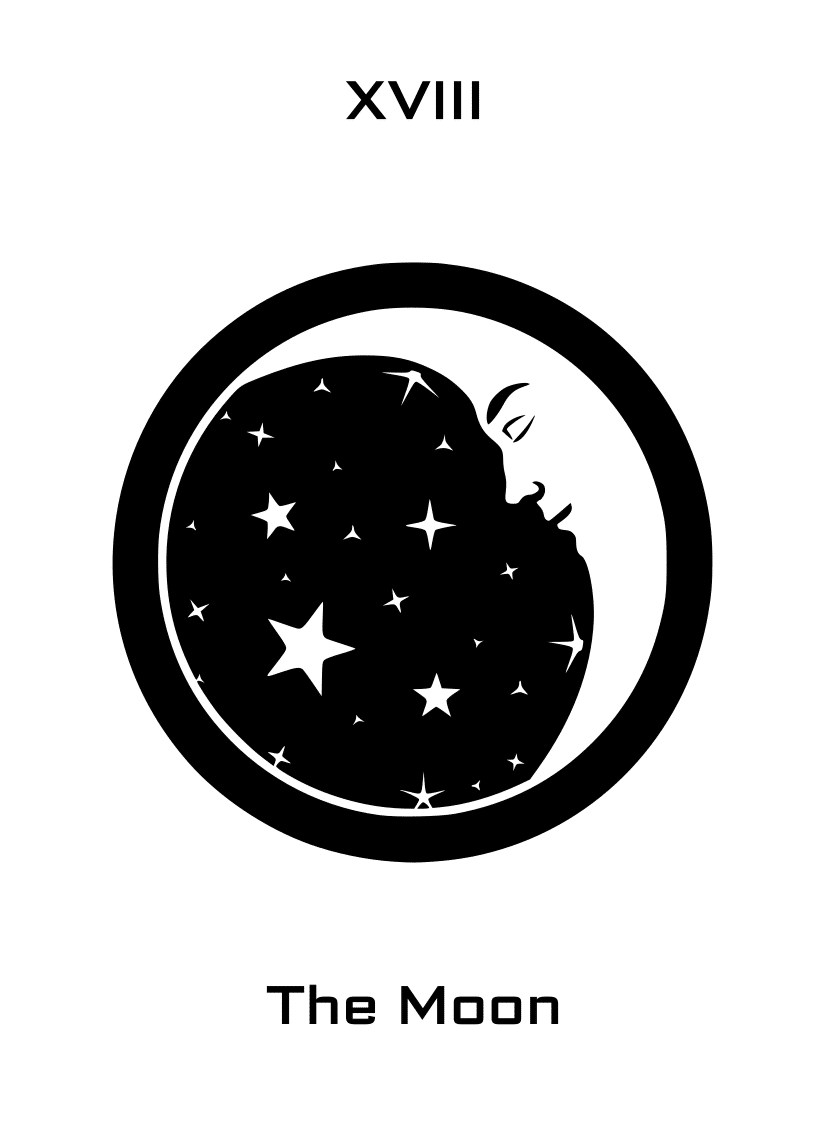
The Moon
Everything looks different in the dark. Don't trust the shadows. Don't ignore them either.
The Moon Upright
The Moon is the card of illusion, uncertainty, dreams and the unlit path. It rules the in-between hours when the world looks half-familiar and your imagination fills the gaps. Traditionally it shows a path winding between two towers beneath a moon that's a little too bright, with creatures howling and crawling around it. The message is that things aren't what they seem, and your fears and fantasies are likely louder than the facts.
In a reading, the Moon says to proceed carefully. You may not have all the information, and some of what you think you know is probably wrong. It's a card for dreams, anxieties, subconscious patterns and situations where intuition and confusion are hard to tell apart. Pay attention to your dreams and your gut feelings, but don't treat every shadow as a monster. Wait for daylight before making big decisions, and write down what you notice. The Moon doesn't give clear answers, but it does show you where to look.
The Moon Reversed
Reversed, the booklet gives clarity returning, fear released and confusion. Dawn is coming. Something that has been murky begins to make sense, or a fear you've been carrying turns out to be smaller than you thought. It's one of the gentler reversals.
There's a catch in the last keyword, though: confusion. Sometimes a reversed Moon means you're still muddled, but the fog is starting to lift. Don't rush to a conclusion just because the light is changing. Give your eyes time to adjust, and trust what's actually in front of you instead of what you've imagined. If you've been awake worrying, the reversed Moon says go to sleep. It will look better in the morning.
The Icon on The Moon
The Ikonology Moon is a crescent, but a crescent that's been filled in with the night: a dark disc covered in stars of all sizes, with a faint sleepy face carved into one edge. The edge face is the old “man in the moon” and it makes the card feel a little watchful. We folded the night sky into the moon itself so the icon is only ever one object: the thing you're looking at and the dark you can't see through, in a single shape.
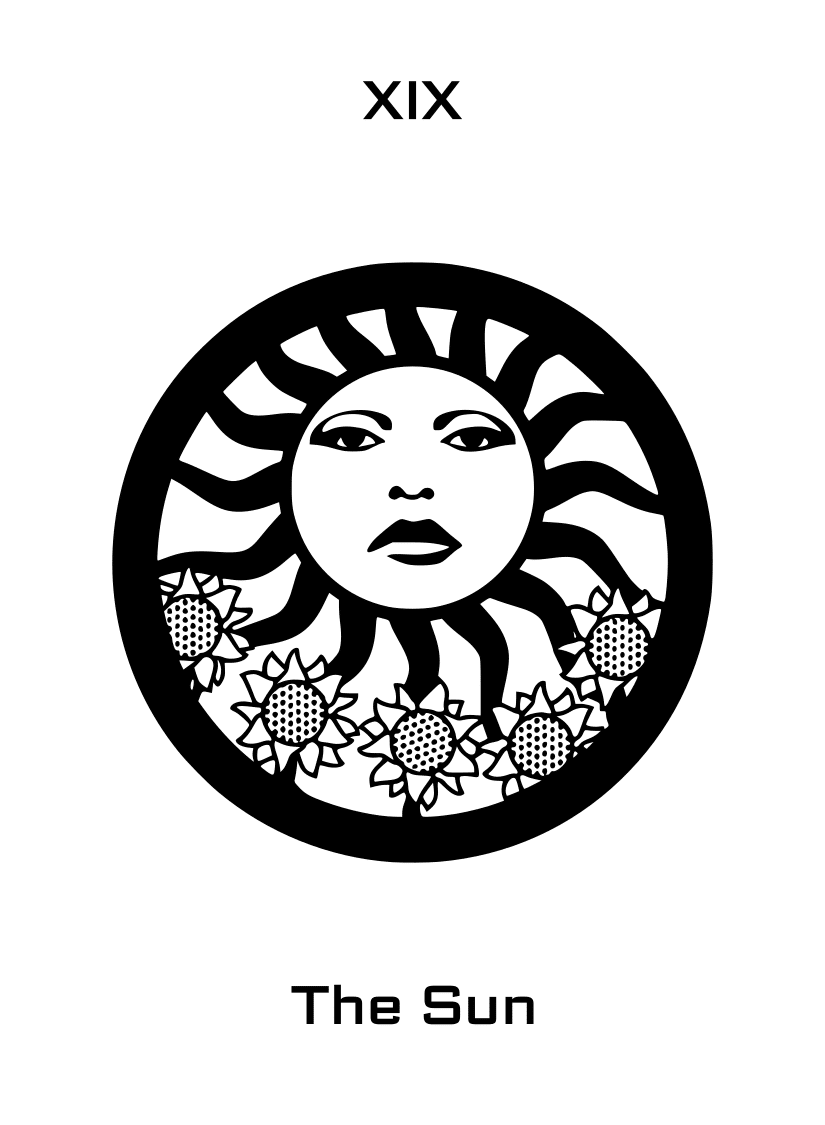
The Sun
Good news, finally. Please stand in it for a while.
The Sun Upright
The Sun is the card of joy, vitality, clarity and success in the open. It's the brightest card in the deck and one of the simplest to read: things are going well. Children play, sunflowers turn their faces up, and nothing is hidden. Where the Moon was uncertainty, the Sun is daylight. Things are visible, warm and honest. You know where you stand.
In a reading, the Sun means confidence, happiness and success you can share. It often points to a time of good health, creative energy and a sense that you're in the right place. Projects flourish, relationships feel easy, and honesty comes naturally. It's also a card about being seen: you don't need to hide your talents, your enthusiasm or your joy. Let people see you do well. Enjoy the sunshine, thank the people who helped you get here, and have a slice of cake. A card this cheerful deserves it.
The Sun Reversed
Reversed, the booklet reads overconfidence, dimmed optimism and delay. The Sun is still in the sky, but a cloud has drifted over. You may be too sure of yourself, assuming success without doing the last bit of work. Or your enthusiasm has dipped, and everything feels a notch less bright than it should.
The reversed Sun isn't a disaster. It's a good time to check your assumptions and to take care of your energy. Success may simply be taking longer than hoped. Resist the urge to coast, and don't lose heart. Cloud cover is temporary, and the Sun doesn't need your permission to come back.
The Icon on The Sun
Our Sun is a round face ringed by wavy, flame-like rays, with a cluster of sunflowers tucked into the lower edge of the circle. It's the busiest, most detailed icon in the deck, and that's deliberate: every other card has a tight, simple shape, and then the Sun floods the frame. The calm, almost serious expression is a surprise. We wanted a sun that is warm and sure of itself, the sort that doesn't need to grin. The sunflowers are there because they turn toward it, which is basically the card's whole plot.
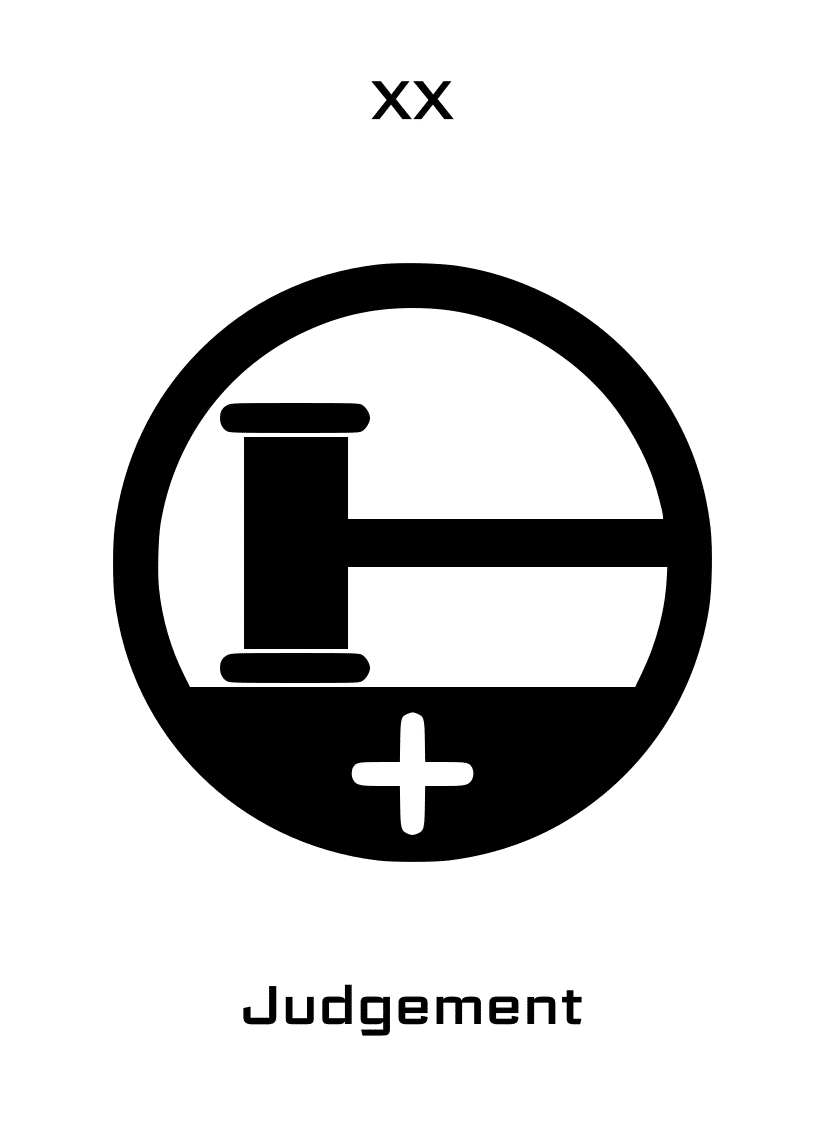
Judgement
Someone just called your name. It's time to answer.
Judgement Upright
Judgement is the card of reckoning, awakening and a calling answered. In the traditional picture, an angel blows a trumpet and the dead rise from their graves with arms outstretched. It's the great wake-up call: a moment when you see your life whole, take stock of what you've done and hear what you're truly meant to do next. The word “judgement” is slightly misleading. This isn't about being found guilty. It's about being called forward.
In a reading, Judgement says a decisive moment has arrived. You may be looking back over your past with a clear eye, forgiving yourself for old mistakes, or answering a calling you've been putting off. It often marks a rebirth: a new phase based on what you've learned, a career change, a reconciliation, a decision you now see clearly. Listen for what's calling you. Then be ready to leave the old self behind. The call won't wait forever, but it's generous enough to ask more than once.
Judgement Reversed
Reversed, the booklet gives self-doubt, the call ignored and harsh verdict. You may be judging yourself far more severely than anyone else would, replaying old mistakes and letting them define you. Or the call is coming, loud and clear, and you're pulling the covers over your head.
A reversed Judgement is an invitation to be fairer to yourself. Treat yourself the way you'd treat a friend in the same spot: with honesty, but also with mercy. Then ask what you've been avoiding. A calling ignored doesn't go away; it just gets louder. Answer it a little at a time if that's what it takes.
The Judgement Icon
The Ikonology Judgement is a gavel, the judge's hammer, sitting beside a bold plus sign. We swapped the angel's trumpet for a gavel because a gavel is the modern sound of a verdict, and the plus is there to keep the card on the right side of mercy: a judgement that adds up, not one that tears down. It's the most modern icon in the deck, and probably the one that raises the most eyebrows. We think it reads clearly. A decision has been made, and it's a good one.
The World
You did it. The circle is closed. Take a bow, then check what comes next.
The World Upright
The World is the card of completion, integration and the circle closed. It's the last of the Major Arcana, and it marks the end of the Fool's long journey. Everything the earlier cards taught (courage, discipline, loss, hope, truth) has been taken in and brought together. It's the sense of finishing something whole, and of belonging to the world rather than standing outside it. A degree finished, a book published, a long project delivered, a personal chapter closed.
In a reading, the World says you've reached a milestone and you're allowed to feel the satisfaction of it. It also points to travel, wide horizons and a feeling of connection with something larger. But the card has a second face. Because the circle is a circle, the end of one journey leads to the beginning of another, and the Fool is waiting by the door with a new bag. Celebrate first. Then look up and ask where you'd like to go next.
The World Reversed
Reversed, the booklet gives unfinished business, shortcuts and delay. You're nearly there, but a last piece isn't in place. It could be a loose end you've been ignoring, a corner you cut to save time, or a project that's stuck at ninety percent because the final ten is dull.
The reversed World asks you to finish properly. Go back to what you skipped, wrap up the odd jobs and make sure the foundation is solid. Delay isn't failure, but a completion that rests on a shortcut won't feel like one. Close the circle fully and you'll enjoy the next beginning a lot more.
The Icon on The World
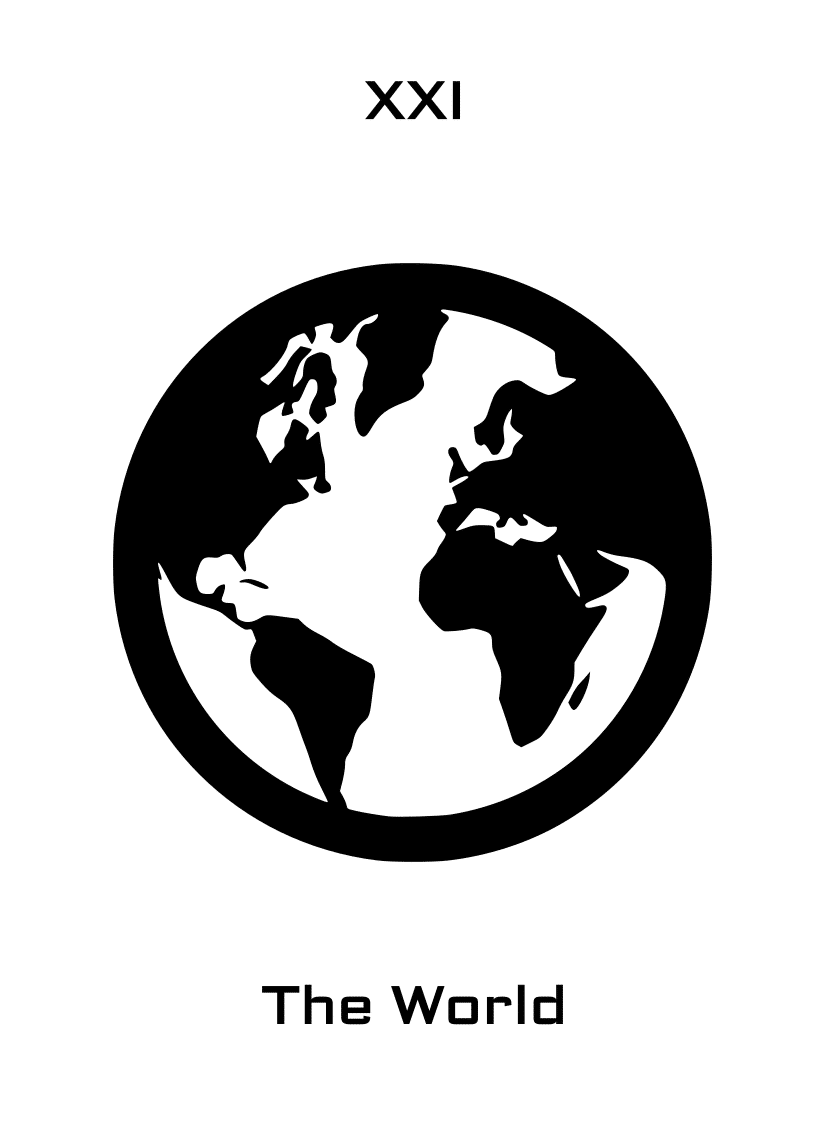
The World is a globe: a simple black-and-white picture of the Earth showing Africa, Europe and the Americas, held inside the plain circle every card shares. It's the most literal icon in the deck, and the only one where the circle on the outside and the thing inside are the same shape. We chose it because the card is about wholeness. Everything the earlier cards were reaching for is here: the circle completed, and the world in it.
Where to Go From Here
The Major Arcana are the big themes. The Minor Arcana are the day-to-day details: the fifty-six numbered and court cards across four suits that make up most of any reading. In the Ikonology deck the suits are matched to their poker equivalents, so Wands are Clubs, Cups are Hearts, Swords are Spades and Pentacles are Diamonds. Each suit has its own page:
- Ikonology Wands (Clubs) meanings
- Ikonology Cups (Hearts) meanings
- Ikonology Swords (Spades) meanings
- Ikonology Pentacles (Diamonds) meanings
Frequently Asked Questions
Are these the traditional tarot meanings?
Yes. The meanings here follow the long tradition of the Major Arcana, written in plain language. What's different about Ikonology is the imagery: each card is a single icon instead of a scene, so the meanings come from the symbol and the number rather than from reading a picture story.
Do I have to use reversed meanings?
No. Many readers never use them. Each Ikonology card reads one way up (the Major Arcana have the numeral at the top and the name at the bottom), so you can read reversals when you want them and ignore them when you don't.
How many cards are in the Major Arcana?
Twenty-two, numbered 0 to XXI: The Fool, The Magician, The High Priestess, The Empress, The Emperor, The Hierophant, The Lovers, The Chariot, Strength, The Hermit, The Wheel of Fortune, Justice, The Hanged Man, Death, Temperance, The Devil, The Tower, The Star, The Moon, The Sun, Judgement and The World. Together with the fifty-six Minor Arcana they make the full seventy-eight-card tarot deck.
Can I use the Ikonology deck for poker too?
Yes. Remove the twenty-two Major Arcana and the four Pages and you're left with a standard fifty-two-card poker deck in four colors, with the Knights marked as Jacks. The Ikonology deck page explains the poker, solitaire and oracle uses in full.
Where can I buy the deck?
Ikonology is available from The Game Crafter. Get Ikonology here.
Check Out FatMunkey's Books
FatMunkey has a huge selection of sudoku and other puzzle books you are sure to enjoy.
Have look at this post to see all of the books and read about what FatMunkey has published so far.